EPUB · English
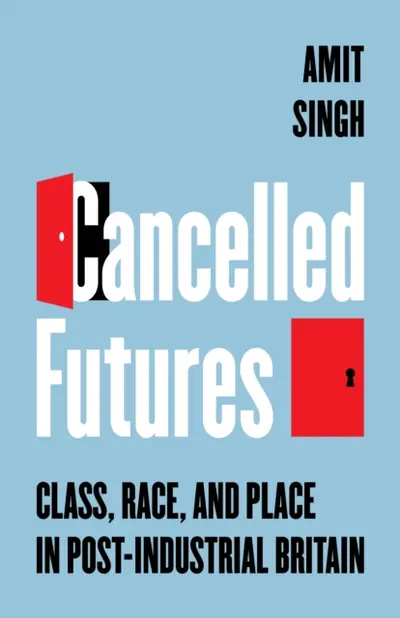
Cancelled Futures
Class, Race, and Place in Post-Industrial Britain
Price and availability
$33.99
Available in: Andorra, Austria, Australia, Belgium, Bulgaria, Canada, Switzerland, Cyprus, Czechia, Germany, Denmark, Estonia, Spain, Finland, France, United Kingdom, Guernsey, Greece, Croatia, Hungary, Ireland, Isle of Man, Iceland, Italy, Jersey, Japan, Liechtenstein, Lithuania, Luxembourg, Latvia, Monaco, Malta, Netherlands, Norway, Poland, Portugal, Romania, Sweden, Slovenia, Slovakia, San Marino, United States, Vatican City, South Africa
Stores: US, UK, Canada, EU, Australia.
Sign in to buyThe price is re-checked by the server before payment.
For personal use under the eBook licence.
- Format
- EPUB
- DRM
- Not stated by the publisher
- Language
- English
- Publisher
- Princeton University Press
- Published
- 8 September 2026
- ISBN
- 9780691293202
- Subjects
- United Kingdom, Great Britain, Cultural studies, Social classes, Ethnic studies, Human geography, Cultural studies, Social classes, Human geography
About this book
How race, class, gender, and place shape the ways working-class young people in Britain envision their transition from education to workHow do the effects of deindustrialisation and neoliberalism influence young people's perceptions of work and education? In Cancelled Futures, Amit Singh examines how experiences of class-based inequality work through race, place, and gender in different ways. Moving beyond the usual framing of race versus class and the populist fixation with the white working class, Singh shows the intractable challenges that Black, Asian, and white young people share when they envision their futures in changing labour market conditions. Drawing on extensive interviews with sixty-two young working-class Britons, he describes the range of strategies they employ in the absence of viable economic opportunitiesand the uneven results that follow.Singh offers a vivid nationwide portrait, bringing together seemingly divergent locations and their youththose living in proximity to the extraordinary wealth and perceived opportunity of the City of London, in the former northern mill town of Rochdale, and in the forgotten seaside town of Morecambe Bayand captures the empathetic sense of struggle that many cultivate. Singh reveals that although the unique features of place raise distinctive racial and gendered reckonings with their circumstances and hopes, these young people have in common an increasingly fading sense of the future. Singh shows that they do not cling to the illusion that hard work pays off or the myth of meritocracy, but seek only to realise some sense of dignity and meaning amid a future that feels not just confusing but altogether absent.
Bibliographic data © Gardners Books Ltd.