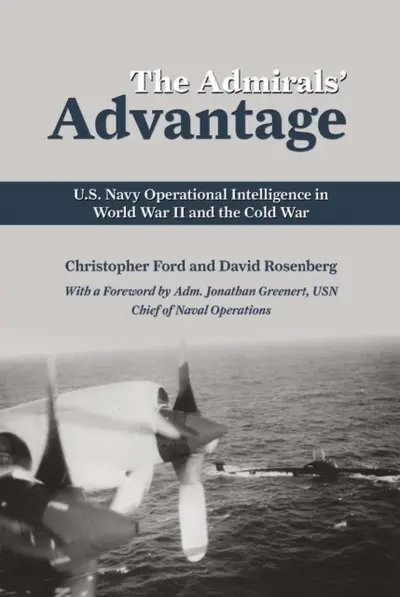
PDF · English
Admirals' Advantage
U.S. Navy Operational Intelligence in World War II and the Cold War
Price and availability
$43.99
Available in: Andorra, Austria, Australia, Belgium, Bulgaria, Canada, Switzerland, Cyprus, Czechia, Germany, Denmark, Estonia, Spain, Finland, France, United Kingdom, Guernsey, Greece, Croatia, Hungary, Ireland, Isle of Man, Iceland, Italy, Jersey, Japan, Liechtenstein, Lithuania, Luxembourg, Latvia, Monaco, Malta, Netherlands, Norway, Poland, Portugal, Romania, Sweden, Slovenia, Slovakia, San Marino, United States, Vatican City, South Africa
Stores: US, UK, Canada, EU, Australia.
Sign in to buyThe price is re-checked by the server before payment.
For personal use under the eBook licence.
- Format
- DRM
- Not stated by the publisher
- Language
- English
- Publisher
- Naval Institute Press
- Published
- 15 April 2014
- ISBN
- 9781612513300
- Subjects
- General & world history, History of the Americas, Postwar 20th century history, from c 1945 to c 2000, Military history, Second World War, Naval forces & warfare, Military intelligence, Battles & campaigns, JWCK, Military intelligence, Battles / military campaigns, NH, NHB, NHK, NHW, NHWR7
About this book
This analytic and historical study provides a revealing look at naval operational intelligence by embracing the fundamental question of what OPINTEL is and how it answers the fundamental question "e;Where is the enemy, in what strength, and disposition, and what is he doing right now?"e; It is primarily the result of an Operational Intelligence Lessons-Learned Symposium held at the National Maritime Intelligence Training Center in Dam Neck, Virginia, 12-13 September 1998. The participants included senior intelligence professionals whose mandate was to explore the ramifications of the evolution of naval operational intelligence since World War II. Current practices were also explored with inputs from current practitioners as represented by various fleet and shore commands. Additional sources for the study were oral interviews and correspondence with senior members of the intelligence community. The authors have scrupulously taken the work as close to the edge of security classification as is possible to enhance its value without being damaging to national security.
Bibliographic data © Gardners Books Ltd.