EPUB · English
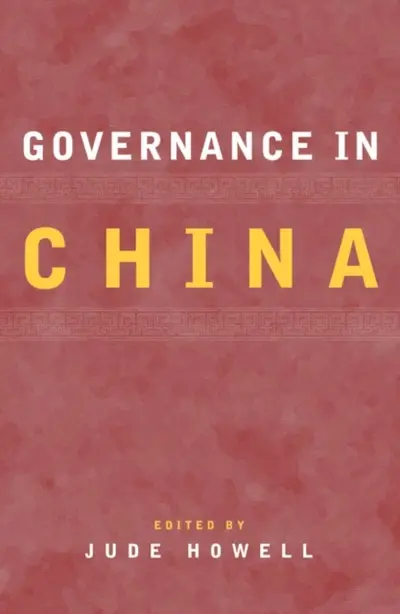
Governance in China
Price and availability
$60.99
Available in: Andorra, Austria, Australia, Belgium, Bulgaria, Canada, Switzerland, Cyprus, Czechia, Germany, Denmark, Estonia, Spain, Finland, France, United Kingdom, Guernsey, Greece, Croatia, Hungary, Ireland, Isle of Man, Iceland, Italy, Jersey, Japan, Liechtenstein, Lithuania, Luxembourg, Latvia, Monaco, Malta, Netherlands, Norway, Poland, Portugal, Romania, Sweden, Slovenia, Slovakia, San Marino, United States, Vatican City, South Africa
Stores: US, UK, Canada, EU, Australia.
Sign in to buyThe price is re-checked by the server before payment.
For personal use under the eBook licence.
- Format
- EPUB
- DRM
- Not stated by the publisher
- Language
- English
- Publisher
- Bloomsbury Publishing (USA)
- Published
- 19 November 2003
- Pages
- 304
- ISBN
- 9781461637028
- Subjects
- China, Regional studies, Politics & government, Political science & theory, History of scholarship (principally of social sciences and humanities), Politics and government, Political science and theory
About this book
Over the past two decades, the Chinese Communist Party (CCP) has paradoxically steered the development of a thriving capitalist economy. Unlike many faltering post-socialist states with fragile economies and weakly institutionalised democratic structures, China has witnessed a tide of economic entrepreneurialism that has raised living standards and the country's global economic stature. However, the strains of rapid economic change and the tensions between an increasingly liberalized economy and the partially reformed institutions of an authoritarian polity have become increasingly severe. Crucial to the success of further economic reform and development, good governance is the greatest challenge faced by the CCP. This groundbreaking book explores the key dimensions of governance in China. These include the prospects for political reform as a new generation of leaders comes to power and China enters the World Trade Organization; the processes of building institutions, such as developing a clean, competent, and meritocracy-based civil service, and improving the legislative framework; enhancing regime legitimacy through the sharing of power at lower levels and promoting citizen participation and voice; and finally the prevention and management of social discontent, with particular reference to worker unrest and the Falun Gong. Drawing on original fieldwork, the international group of authors provides a systematic analysis of the political, institutional, and economic causes underlying China's governance problems and considers the prospects for future social and political change.
Bibliographic data © Gardners Books Ltd.