PDF · English
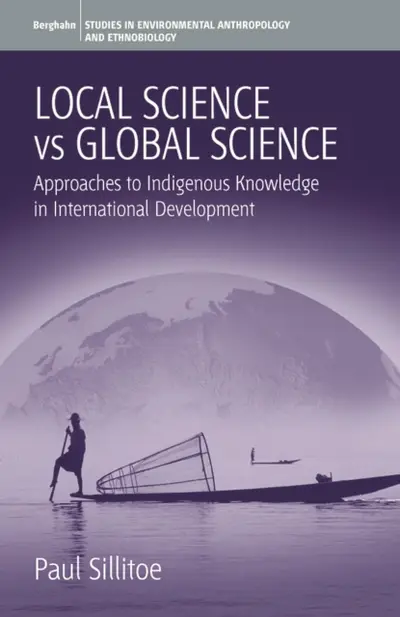
Local Science Vs Global Science
Approaches to Indigenous Knowledge in International Development
- Society & social sciences
- Economics, business & finance
- Nature, environment & geography
- Technology & engineering
- Reference
Price and availability
$24.99
Available in: Andorra, Austria, Australia, Belgium, Bulgaria, Canada, Switzerland, Cyprus, Czechia, Germany, Denmark, Estonia, Spain, Finland, France, United Kingdom, Guernsey, Greece, Croatia, Hungary, Ireland, Isle of Man, Iceland, Italy, Jersey, Japan, Liechtenstein, Lithuania, Luxembourg, Latvia, Monaco, Malta, Netherlands, Norway, Poland, Portugal, Romania, Sweden, Slovenia, Slovakia, San Marino, United States, Vatican City, South Africa
Stores: US, UK, Canada, EU, Australia.
Sign in to buyThe price is re-checked by the server before payment.
For personal use under the eBook licence.
- Format
- DRM
- Not stated by the publisher
- Language
- English
- Publisher
- Berghahn Books
- Published
- 1 December 2006
- ISBN
- 9781782382102
- Subjects
- Developing countries, Development studies, Development economics & emerging economies, Environmental science, engineering & technology, Anthropology, The environment
About this book
While science has achieved a remarkable understanding of nature, affording humans an astonishing technological capability, it has led, through Euro-American global domination, to the muting of other cultural views and values, even threatening their continued existence. There is a growing realization that the diversity of knowledge systems demand respect, some refer to them in a conservation idiom as alternative information banks. The scientific perspective is only one. We now have many examples of the soundness of local science and practices, some previously considered primitive and in need of change, but this book goes beyond demonstrating the soundness of local science and arguing for the incorporation of others knowledge in development, to argue that we need to look quizzically at the foundations of science itself and further challenge its hegemony, not only over local communities in Africa, Asia, the Pacific or wherever, but also the global community. The issues are large and the challenges are exciting, as addressed in this book, in a range of ethnographic and institutional contexts.
Bibliographic data © Gardners Books Ltd.