PDF · English
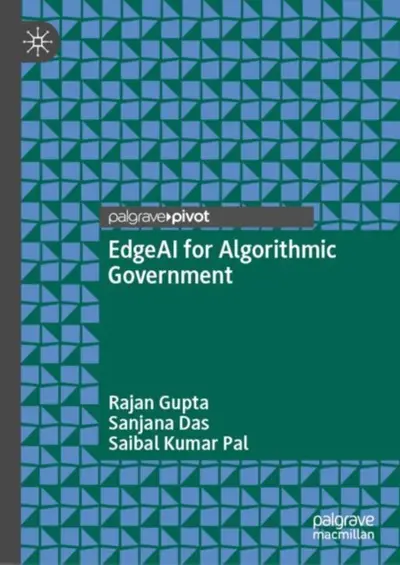
EdgeAI for Algorithmic Government
Price and availability
$54.99
Available in: Andorra, Austria, Australia, Belgium, Bulgaria, Canada, Switzerland, Cyprus, Czechia, Germany, Denmark, Estonia, Spain, Finland, France, United Kingdom, Guernsey, Greece, Croatia, Hungary, Ireland, Isle of Man, Iceland, Italy, Jersey, Japan, Liechtenstein, Lithuania, Luxembourg, Latvia, Monaco, Malta, Netherlands, Norway, Poland, Portugal, Romania, Sweden, Slovenia, Slovakia, San Marino, United States, Vatican City, South Africa
Stores: US, UK, Canada, EU, Australia.
Sign in to buyThe price is re-checked by the server before payment.
For personal use under the eBook licence.
- Format
- DRM
- Not stated by the publisher
- Language
- English
- Publisher
- Springer Nature Singapore
- Published
- 26 March 2023
- ISBN
- 9789811997983
- Subjects
- Developing countries, Development studies, Central government, Central government policies, Parliamentary & legislative practice, Computer science, Mathematical theory of computation, Artificial intelligence, Development studies, Central / national / federal government, Parliamentary and legislative practice, Mathematical theory of computation, Artificial intelligence (AI)
About this book
The book provides various EdgeAI concepts related to its architecture, key performance indicators, and enabling technologies after introducing algorithmic government, large-scale decision-making, and computing issues in the cloud and fog. With advancements in technology, artificial intelligence has permeated our personal lives and the fields of economy, socio-culture, and politics. The integration of artificial intelligence (AI) into decision-making for public services is changing how governments operate worldwide. This book discusses how algorithms help the government in various ways, including virtual assistants for busy civil servants, automated public services, and algorithmic decision-making processes. In such cases, the implementation of algorithms will occur on a massive scale and possibly affect the lives of entire communities. The cloud-centric architecture of artificial intelligence brings out challenges of latency, overhead communication, and significant privacy risks. Due to the sheer volume of data generated by IoT devices, the data analysis must be performed at the forefront of the network. This introduces the need for edge computing in algorithmic government. EdgeAI, the confluence of edge computing and AI, is the primary focus of this book. It also discusses how one can incorporate these concepts in algorithmic government through conceptual framework and decision points. Finally, the research work emphasizes some design challenges in edge computing from applications viewpoint. This book will be helpful for data engineers, data scientists, cloud engineers, data management experts, public policymakers, administrators, research scholars and academicians.
Bibliographic data © Gardners Books Ltd.