EPUB · English
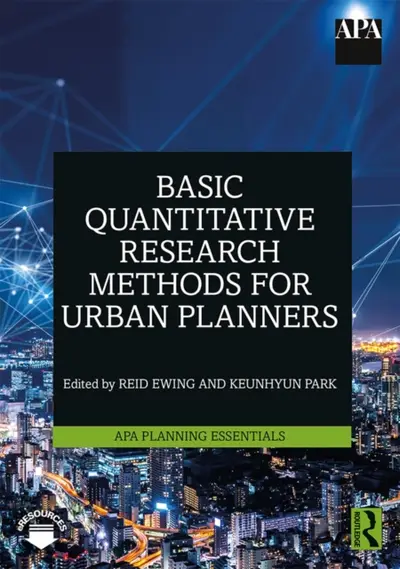
Basic Quantitative Research Methods for Urban Planners
Price and availability
$55.99
Available in: Andorra, Austria, Australia, Belgium, Bulgaria, Canada, Switzerland, Cyprus, Czechia, Germany, Denmark, Estonia, Spain, Finland, France, United Kingdom, Guernsey, Greece, Croatia, Hungary, Ireland, Isle of Man, Iceland, Italy, Jersey, Japan, Liechtenstein, Lithuania, Luxembourg, Latvia, Monaco, Malta, Netherlands, Norway, Poland, Portugal, Romania, Sweden, Slovenia, Slovakia, San Marino, United States, Vatican City, South Africa
Stores: US, UK, Canada, EU, Australia.
Sign in to buyThe price is re-checked by the server before payment.
For personal use under the eBook licence.
- Format
- EPUB
- DRM
- Not stated by the publisher
- Language
- English
- Publisher
- Taylor & Francis
- Published
- 24 February 2020
- ISBN
- 9781000769357
- Subjects
- Research methods: general, Urban & municipal planning, Research methods / methodology, Probability and statistics, Urban and municipal planning and policy
About this book
In most planning practice and research, planners work with quantitative data. By summarizing, analyzing, and presenting data, planners create stories and narratives that explain various planning issues. Particularly, in the era of big data and data mining, there is a stronger demand in planning practice and research to increase capacity for data-driven storytelling. Basic Quantitative Research Methods for Urban Planners provides readers with comprehensive knowledge and hands-on techniques for a variety of quantitative research studies, from descriptive statistics to commonly used inferential statistics. It covers statistical methods from chi-square through logistic regression and also quasi-experimental studies. At the same time, the book provides fundamental knowledge about research in general, such as planning data sources and uses, conceptual frameworks, and technical writing. The book presents relatively complex material in the simplest and clearest way possible, and through the use of real world planning examples, makes the theoretical and abstract content of each chapter as tangible as possible. It will be invaluable to students and novice researchers from planning programs, intermediate researchers who want to branch out methodologically, practicing planners who need to conduct basic analyses with planning data, and anyone who consumes the research of others and needs to judge its validity and reliability.
Bibliographic data © Gardners Books Ltd.