PDF · English
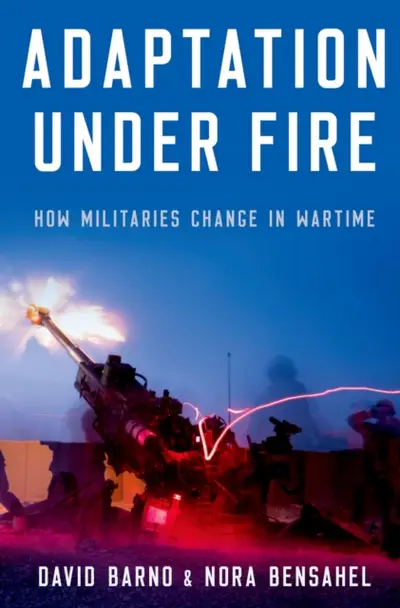
Adaptation under Fire
How Militaries Change in Wartime
Price and availability
$18.99
Available in: Andorra, Austria, Australia, Belgium, Bulgaria, Canada, Switzerland, Cyprus, Czechia, Germany, Denmark, Estonia, Spain, Finland, France, United Kingdom, Guernsey, Greece, Croatia, Hungary, Ireland, Isle of Man, Iceland, Italy, Jersey, Japan, Liechtenstein, Lithuania, Luxembourg, Latvia, Monaco, Malta, Netherlands, Norway, Poland, Portugal, Romania, Sweden, Slovenia, Slovakia, San Marino, United States, Vatican City, South Africa
Stores: US, UK, Canada, EU, Australia.
Sign in to buyThe price is re-checked by the server before payment.
For personal use under the eBook licence.
- Format
- DRM
- Not stated by the publisher
- Language
- English
- Publisher
- Oxford University Press
- Published
- 17 August 2020
- ISBN
- 9780190672065
- Subjects
- United Kingdom, Great Britain, Military history, Geopolitics, Defence strategy, planning & research, Geopolitics, Military and defence strategy, NHW
About this book
A critical look into how and why the U.S. military needs to become more adaptable.Every military must prepare for future wars despite not really knowing the shape such wars will ultimately take. As former U.S. Secretary of Defense Robert Gates once noted: "e;We have a perfect record in predicting the next war. We have never once gotten it right."e; In the face of such great uncertainty, militaries must be able to adapt rapidly in order to win. Adaptation under Fire identifies the characteristics that make militaries more adaptable, illustrated through historical examples and the recent wars in Iraq and Afghanistan. Authors David Barno and Nora Bensahel argue that militaries facing unknown future conflicts must nevertheless make choices about the type of doctrine that their units will use, the weapons and equipment they will purchase, and the kind of leaders they will select and develop to guide the force to victory. Yet after a war begins, many of these choices will prove flawed in the unpredictable crucible of the battlefield. For a U.S. military facing diverse global threats, its ability to adapt quickly and effectively to those unforeseen circumstances may spell the difference between victory and defeat. Barno and Bensahel start by providing a framework for understanding adaptation and include historical cases of success and failure. Next, they examine U.S. military adaptation during the nation's recent wars, and explain why certain forms of adaptation have proven problematic. In the final section, Barno and Bensahel conclude that the U.S. military must become much more adaptable in order to address the fast-changing security challenges of the future, and they offer recommendations on how to do so before it is too late.
Bibliographic data © Gardners Books Ltd.