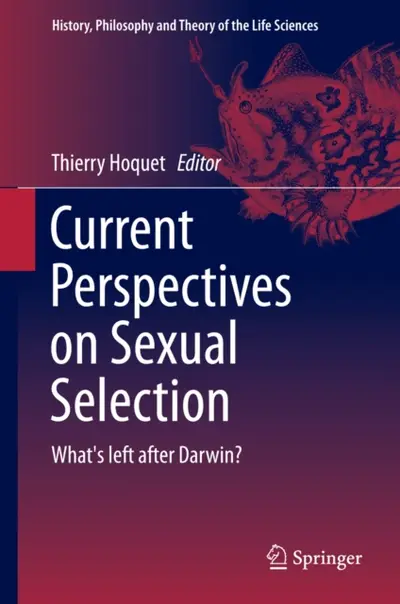
PDF · English
Current Perspectives on Sexual Selection
What''s left after Darwin?
Price and availability
$74.99
Available in: Andorra, Austria, Australia, Belgium, Bulgaria, Canada, Switzerland, Cyprus, Czechia, Germany, Denmark, Estonia, Spain, Finland, France, United Kingdom, Guernsey, Greece, Croatia, Hungary, Ireland, Isle of Man, Iceland, Italy, Jersey, Japan, Liechtenstein, Lithuania, Luxembourg, Latvia, Monaco, Malta, Netherlands, Norway, Poland, Portugal, Romania, Sweden, Slovenia, Slovakia, San Marino, United States, Vatican City, South Africa
Stores: US, UK, Canada, EU, Australia.
Sign in to buyThe price is re-checked by the server before payment.
For personal use under the eBook licence.
- Format
- DRM
- Not stated by the publisher
- Language
- English
- Publisher
- Springer Netherlands
- Published
- 28 January 2015
- ISBN
- 9789401795852
- Subjects
- Philosophy: epistemology & theory of knowledge, Social, group or collective psychology, Sexual behaviour, Philosophy of science, Evolution, Animal behaviour, Psychology of gender, Biology, life sciences, Evolution / Evolutionary biology, Philosophy
About this book
This root-and-branch re-evaluation of Darwin's concept of sexual selection tackles the subject from historical, epistemological and theoretical perspectives. Contributions from a wealth of disciplines have been marshaled for this volume, with key figures in behavioural ecology, philosophy, and the history of science adding to its wide-ranging relevance. Updating the reader on the debate currently live in behavioural ecology itself on the centrality of sexual selection, and with coverage of developments in the field of animal aesthetics, the book details the current state of play, while other chapters trace the history of sexual selection from Darwin to today and inquire into the neurobiological bases for partner choices and the comparisons between the hedonic brain in human and non-human animals.Welcome space is given to the social aspects of sexual selection, particularly where Darwin drew distinctions between eager males and coy females and rationalized this as evolutionarystrategy. Also explored are the current definition of sexual selection (as opposed to natural selection) and its importance in today's biological research, and the impending critique of the theory from the nascent field of animal aesthetics. As a comprehensive assessment of the current health, or otherwise, of Darwin's theory, 140 years after the publication of his Descent of Man, the book offers a uniquely rounded view that asks whether 'sexual selection' is in itself a progressive or reactionary notion, even as it explores its theoretical relevance in the technical biological study of the twenty-first century.
Bibliographic data © Gardners Books Ltd.