EPUB · English
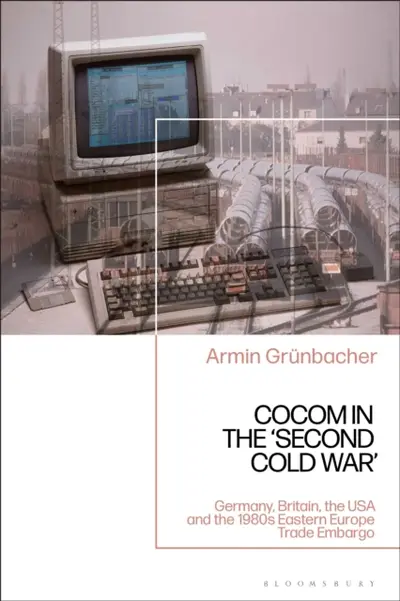
CoCom in the Second Cold War
Germany, Britain, the USA and the 1980s Eastern Europe Trade Embargo
Price and availability
$103.99
Not available to buy yet.
Available in: Andorra, Austria, Australia, Belgium, Bulgaria, Canada, Switzerland, Cyprus, Czechia, Germany, Denmark, Estonia, Spain, Finland, France, United Kingdom, Guernsey, Greece, Croatia, Hungary, Ireland, Isle of Man, Iceland, Italy, Jersey, Japan, Liechtenstein, Lithuania, Luxembourg, Latvia, Monaco, Malta, Netherlands, Norway, Poland, Portugal, Romania, Sweden, Slovenia, Slovakia, San Marino, United States, Vatican City, South Africa
Stores: US, UK, Canada, EU, Australia.
This title cannot be bought in this store yet: its supplier terms, territorial rights or price are still being confirmed.
For personal use under the eBook licence.
- Format
- EPUB
- DRM
- Not stated by the publisher
- Language
- English
- Publisher
- Bloomsbury Publishing
- Published
- 24 December 2026
- Pages
- 264
- ISBN
- 9781350377417
- Subjects
- 20th century, The Cold War, International relations, Economic history, 3MP, International relations, Economic history, NHTW
About this book
This study investigates the German, British and wider European reactions to the US revival of the CoCom trade embargo against the Eastern Bloc after 1980. It shows how the Europeans tried to balance alliance loyalties within NATO with their considerable economic and trade interests in Eastern Europe. Armin Gr nbacher considers how, with the West suffering in the wake of the 2nd oil shock and, due to the rhetoric of the early Reagan administration, US-Soviet relations reaching a low point, the Europeans believed in and persisted with a 'peace through trade' approach. By analysing the response of German business associations and leaders, CoCom in the 'Second Cold War' offers both a political history of the 2nd Cold War and a unique contribution to the economic history of the Cold War. This includes European responses to the Reagan Administration's lifting of grain export sanctions to the USSR, while simultaneously tightening industrial export restriction which mainly affected the European industries. Indeed a key feature of the book is the investigation of European positions on the implementation of extra-territorial US sanctions against European firms who were suspected by the US to be in breach of the embargo. Gr nbacher argues that the disputes within the Western alliance reached a second climax with the so-called 'West-West- embargo' in about 1986, when German firms in particular were excluded from any contracts which would involve 'SDI-technology' (Reagan's infamous 'Star Wars' programme) and German scientists were even prevented from attending civilian conferences in the USA for fear of espionage.
Bibliographic data © Gardners Books Ltd.