PDF · English
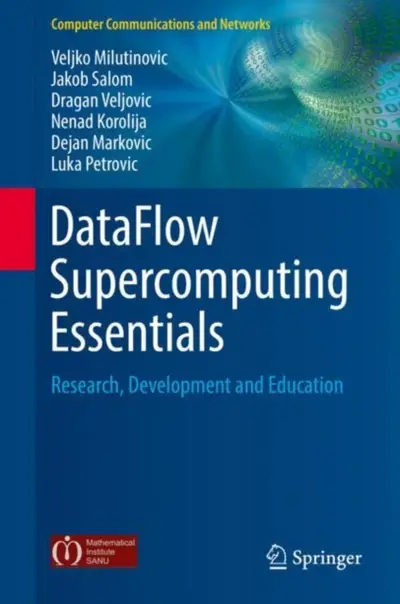
DataFlow Supercomputing Essentials
Research, Development and Education
Price and availability
$120.99
Available in: Andorra, Austria, Australia, Belgium, Bulgaria, Canada, Switzerland, Cyprus, Czechia, Germany, Denmark, Estonia, Spain, Finland, France, United Kingdom, Guernsey, Greece, Croatia, Hungary, Ireland, Isle of Man, Iceland, Italy, Jersey, Japan, Liechtenstein, Lithuania, Luxembourg, Latvia, Monaco, Malta, Netherlands, Norway, Poland, Portugal, Romania, Sweden, Slovenia, Slovakia, San Marino, United States, Vatican City, South Africa
Stores: US, UK, Canada, EU, Australia.
Sign in to buyThe price is re-checked by the server before payment.
For personal use under the eBook licence.
- Format
- DRM
- Not stated by the publisher
- Language
- English
- Publisher
- Springer International Publishing
- Published
- 30 October 2017
- ISBN
- 9783319661285
- Subjects
- Probability & statistics, Computer hardware, Operating systems, Databases, Systems analysis & design, Computer architecture & logic design, Computer hardware, Operating systems, Databases / Data management, Systems analysis and design
About this book
This informative text/reference highlights the potential of DataFlow computing in research requiring high speeds, low power requirements, and high precision, while also benefiting from a reduction in the size of the equipment. The cutting-edge research and implementation case studies provided in this book will help the reader to develop their practical understanding of the advantages and unique features of this methodology.This work serves as a companion title to DataFlow Supercomputing Essentials: Algorithms, Applications and Implementations, which reviews the key algorithms in this area, and provides useful examples.Topics and features: reviews the library of tools, applications, and source code available to support DataFlow programming; discusses the enhancements to DataFlow computing yielded by small hardware changes, different compilation techniques, debugging, and optimizing tools; examines when a DataFlow architecture is best applied, and for which types of calculation; describes how converting applications to a DataFlow representation can result in an acceleration in performance, while reducing the power consumption; explains how to implement a DataFlow application on Maxeler hardware architecture, with links to a video tutorial series available online. This enlightening volume will be of great interest to all researchers investigating supercomputing in general, and DataFlow computing in particular. Advanced undergraduate and graduate students involved in courses on Data Mining, Microprocessor Systems, and VLSI Systems, will also find the book to be a helpful reference.
Bibliographic data © Gardners Books Ltd.