EPUB · English
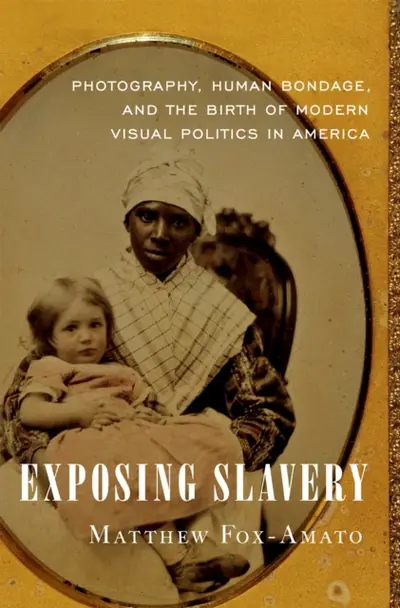
Exposing Slavery
Photography, Human Bondage, and the Birth of Modern Visual Politics in America
Price and availability
$32.99
Available in: Andorra, Austria, Australia, Belgium, Bulgaria, Canada, Switzerland, Cyprus, Czechia, Germany, Denmark, Estonia, Spain, Finland, France, United Kingdom, Guernsey, Greece, Croatia, Hungary, Ireland, Isle of Man, Iceland, Italy, Jersey, Japan, Liechtenstein, Lithuania, Luxembourg, Latvia, Monaco, Malta, Netherlands, Norway, Poland, Portugal, Romania, Sweden, Slovenia, Slovakia, San Marino, United States, Vatican City, South Africa
Stores: US, UK, Canada, EU, Australia.
Sign in to buyThe price is re-checked by the server before payment.
For personal use under the eBook licence.
- Format
- EPUB
- DRM
- Not stated by the publisher
- Language
- English
- Publisher
- Oxford University Press
- Published
- 1 March 2019
- ISBN
- 9780190663957
- Subjects
- USA, c 1800 to c 1900, History of art & design styles: c 1800 to c 1900, Photography & photographs, History of the Americas, Slavery & abolition of slavery, Black & Asian studies, United States of America, USA, 3MN, AGA, Photography and photographs, JBSL, NHK, NHTS
About this book
Within a few years of the introduction of photography into the United States in 1839, slaveholders had already begun commissioning photographic portraits of their slaves. Ex-slaves-turned-abolitionists such as Frederick Douglass had come to see how sitting for a portrait could help them project humanity and dignity amidst northern racism. In the first decade of the medium, enslaved people had begun entering southern daguerreotype studios of their own volition, posing for cameras, and leaving with visual treasures they could keep in their pockets. And, as the Civil War raged, Union soldiers would orchestrate pictures with fugitive slaves that envisioned racial hierarchy as slavery fell. In these ways and others, from the earliest days of the medium to the first moments of emancipation, photography powerfully influenced how bondage and freedom were documented, imagined, and contested. By 1865, it would be difficult for many Americans to look back upon slavery and its fall without thinking of a photograph. Exposing Slavery explores how photography altered and was, in turn, shaped by conflicts over human bondage. Drawing on an original source base that includes hundreds of unpublished and little-studied photographs of slaves, ex-slaves, free African Americans, and abolitionists, as well as written archival materials, it puts visual culture at the center of understanding the experience of late slavery. It assesses how photography helped southerners to defend slavery, enslaved people to shape their social ties, abolitionists to strengthen their movement, and soldiers to pictorially enact interracial society during the Civil War. With diverse goals, these peoples transformed photography from a scientific curiosity into a political tool over only a few decades. This creative first book sheds new light on conflicts over late American slavery, while also revealing a key moment in the relationship between modern visual culture and racialized forms of power and resistance.
Bibliographic data © Gardners Books Ltd.