EPUB · English
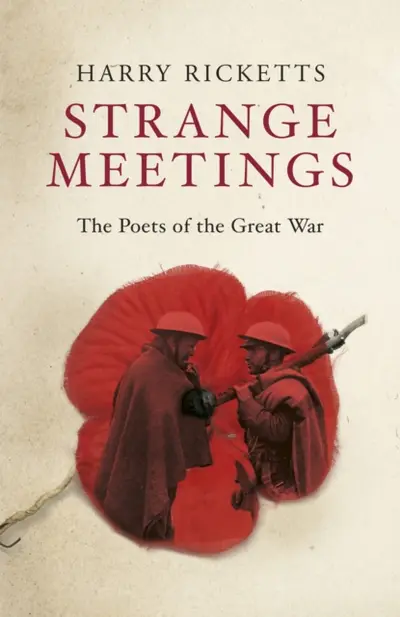
Strange Meetings
The Poets of the Great War
Price and availability
Not sold in this region
Available in: Andorra, Austria, Australia, Belgium, Bulgaria, Switzerland, Cyprus, Czechia, Germany, Denmark, Estonia, Spain, Finland, France, United Kingdom, Guernsey, Greece, Croatia, Hungary, Ireland, Isle of Man, Iceland, Italy, Jersey, Japan, Liechtenstein, Lithuania, Luxembourg, Latvia, Monaco, Malta, Netherlands, Norway, Poland, Portugal, Romania, Sweden, Slovenia, Slovakia, San Marino, Vatican City, South Africa
Stores: UK, EU, Australia. Not available in the United States store.
This title cannot be bought in this store yet: its supplier terms, territorial rights or price are still being confirmed.
For personal use under the eBook licence.
- Format
- EPUB
- DRM
- Not stated by the publisher
- Language
- English
- Publisher
- Random House
- Published
- 26 February 2015
- ISBN
- 9781448129843
- Subjects
- Literary studies: from c 1900 -, Literary studies: poetry & poets, History, Literary studies: c 1900 to c 2000, Literary studies: poetry and poets
About this book
Strange Meetings provides a highly original account of the War Poets of 1914-1918, written through a series of actual encounters, or near-encounters, from Siegfried Sassoon's first, blushing meeting with Rupert Brooke over kidneys and bacon at Eddie Marsh's breakfasts before the war, through famous moments like Sassoon's encouragement of Owen when both are in hospital at the same time; on to the poignant meeting between Edward Thomas's widow and Ivor Gurney in 1932; and the last, strange lunch and 'longish talk' of Sassoon and David Jones in 1964, half a century after the great war began. Among the other poets and writers we encounter are Vera Brittain, Roland Leighton, Robert Graves, Isaac Rosenberg, Robert Nichols and Edmund Blunden. Ricketts's unusual approach allows him to follow their relationships, marking their responses to each other's work and showing how these affected their own poetry - one potent strand, for example, is the profound influence of Brooke, both as a model to follow and a burden to reject. The stories become intensely personal and vivid - we come to know each of the poets, their family and intellectual backgrounds and their very different personalities. And while the accounts of individual lives achieve the imaginative vividness of a novel, they also give us an entirely fresh sense of Georgian poetry, conveying all the excitement and frustration of poetic creation, and demonstrating how the whole notion of what poetry should be 'about' became fractured and changed for ever by the terrible experiences of the war.
Bibliographic data © Gardners Books Ltd.