PDF · English
Cyclops
The Myth and its Cultural History
Price and availability
$39.99
Available in: Andorra, Austria, Australia, Belgium, Bulgaria, Canada, Switzerland, Cyprus, Czechia, Germany, Denmark, Estonia, Spain, Finland, France, United Kingdom, Guernsey, Greece, Croatia, Hungary, Ireland, Isle of Man, Iceland, Italy, Jersey, Japan, Liechtenstein, Lithuania, Luxembourg, Latvia, Monaco, Malta, Netherlands, Norway, Poland, Portugal, Romania, Sweden, Slovenia, Slovakia, San Marino, United States, Vatican City, South Africa
Stores: US, UK, Canada, EU, Australia.
Sign in to buyThe price is re-checked by the server before payment.
For personal use under the eBook licence.
- Format
- DRM
- Not stated by the publisher
- Language
- English
- Publisher
- Oxford University Press
- Published
- 10 May 2020
- ISBN
- 9780191022869
- Subjects
- History of art: ancient & classical art,BCE to c 500 CE, Classical texts, Ancient religions & mythologies, Folklore, myths & legends, History of art, Ancient, classical and medieval texts, Folklore studies / Study of myth, Ancient religions and Mythologies
About this book
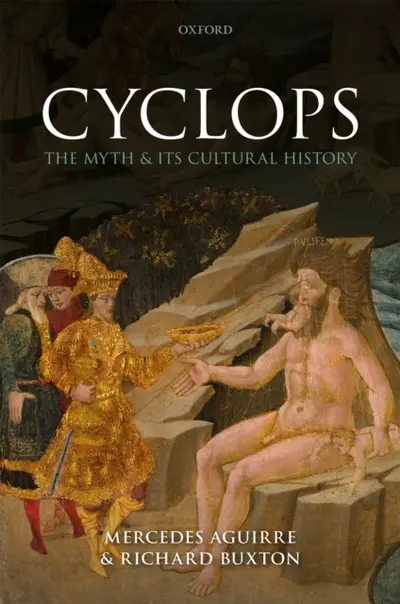
A Cyclops is popularly assumed to be nothing more than a flesh-eating, one-eyed monster. In an accessible, stylish, and academically authoritative investigation, this book seeks to demonstrate that there is far more to it than that - quite apart from the fact that in myths the Cyclopes are not always one-eyed!This book provides a detailed, innovative, and richly illustrated study of the myths relating to the Cyclopes from classical antiquity until the present day. The first part is organised thematically: after discussing various competing scholarly approaches to the myths, the authors analyse ancient accounts and images of the Cyclopes in relation to landscape, physique (especially eyes, monstrosity, and hairiness), lifestyle, gods, names, love, and song. While the man-eating Cyclops Polyphemus, famous already in the Odyssey, plays a major part, so also do the Cyclopes who did monumental building work, as well as those who toiled as blacksmiths. The second part of the book concentrates on the post-classical reception of the myths, including medieval allegory, Renaissance grottoes, poetry, drama, the visual arts, contemporary painting and sculpture, film, and even a circus performance. This book aims to explore not just the perennial appeal of the Cyclopes as fearsome monsters, but the depth and subtlety of their mythology which raises complex issues of thought and emotion.
Bibliographic data © Gardners Books Ltd.