EPUB · English
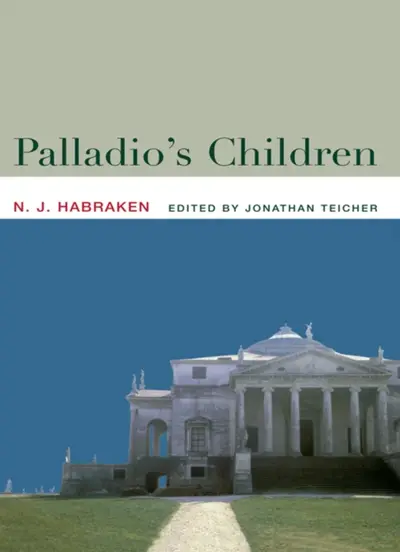
Palladio's Children
Essays on Everyday Environment and the Architect
Price and availability
$59.99
Available in: Andorra, Austria, Australia, Belgium, Bulgaria, Canada, Switzerland, Cyprus, Czechia, Germany, Denmark, Estonia, Spain, Finland, France, United Kingdom, Guernsey, Greece, Croatia, Hungary, Ireland, Isle of Man, Iceland, Italy, Jersey, Japan, Liechtenstein, Lithuania, Luxembourg, Latvia, Monaco, Malta, Netherlands, Norway, Poland, Portugal, Romania, Sweden, Slovenia, Slovakia, San Marino, United States, Vatican City, South Africa
Stores: US, UK, Canada, EU, Australia.
Sign in to buyThe price is re-checked by the server before payment.
For personal use under the eBook licence.
- Format
- EPUB
- DRM
- Not stated by the publisher
- Language
- English
- Publisher
- Taylor & Francis
- Published
- 11 April 2007
- ISBN
- 9781134325399
- Subjects
- Architecture, Theory of architecture, Architecture: professional practice, History of architecture, Civil engineering, surveying & building, Theory of architecture, Architecture: professional practice, History of architecture
About this book
Based on many years of personal observation, Palladio's Children critically examines the role of the architect as a professional descendent of Palladio, and as an heir to his architectural legacy. Seven innovative and carefully crafted essays explore the widening ideological schism between today's architects whose core values, identity and education remain rooted in the Renaissance legacy of creating artful 'masterpieces', and the practical demands on a profession which acts within an evolving, ubiquitous and autonomous built environment or 'field'. Clearly written yet expressing complex, evolving ideas, this extended argument opens a new forum of debate across design theory, professional practice and academic issues. Moving the subject on from a historical perspective, Habraken shows how architects are increasingly involved in the design of everyday buildings. This must lead to a reassessment of architects' identities, values and education, and the contribution of the architect in the shaping of the built environment.
Bibliographic data © Gardners Books Ltd.