EPUB · English
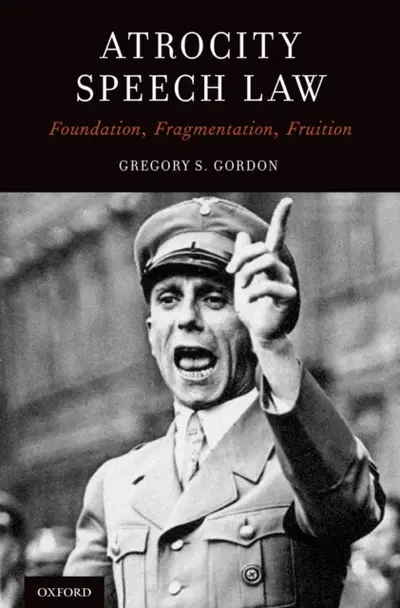
Atrocity Speech Law
Foundation, Fragmentation, Fruition
Price and availability
$109.99
Available in: Andorra, Austria, Australia, Belgium, Bulgaria, Canada, Switzerland, Cyprus, Czechia, Germany, Denmark, Estonia, Spain, Finland, France, United Kingdom, Guernsey, Greece, Croatia, Hungary, Ireland, Isle of Man, Iceland, Italy, Jersey, Japan, Liechtenstein, Lithuania, Luxembourg, Latvia, Monaco, Malta, Netherlands, Norway, Poland, Portugal, Romania, Sweden, Slovenia, Slovakia, San Marino, United States, Vatican City, South Africa
Stores: US, UK, Canada, EU, Australia.
Sign in to buyThe price is re-checked by the server before payment.
For personal use under the eBook licence.
- Format
- EPUB
- DRM
- Not stated by the publisher
- Language
- English
- Publisher
- Oxford University Press
- Published
- 11 April 2017
- ISBN
- 9780190612702
- Subjects
- Genocide & ethnic cleansing, Human rights, Public international law, International human rights law, International criminal law, Human rights, civil rights, Public international law, Public international law: human rights, Public international law: criminal law, NHTZ
About this book
The law governing the relationship between speech and core international crimes - a key component in atrocity prevention - is broken. Incitement to genocide has not been adequately defined. The law on hate speech as persecution is split between the International Criminal Tribunal for Rwanda (ICTR) and the International Criminal Tribunal for the former Yugoslavia (ICTY). Instigation is confused with incitement and ordering's scope is too circumscribed. At the same time, each of these modalities does not function properly in relation to the others, yielding a misshapen body of law riddled with gaps. Existing scholarship has suggested discrete fixes to individual parts, but no work has stepped back and considered holistic solutions. This book does. To understand how the law became so fragmented, it returns to its roots to explain how it was formulated. From there, it proposes a set of nostrums to deal with the individual deficiencies. Its analysis then culminates in a more comprehensive proposal: a Unified Liability Theory, which would systematically link the core crimes of genocide, crimes against humanity, and war crimes with the four illicit speech modalities. The latter would be placed in one statutory provision criminalizing the following types of speech: (1) incitement (speech seeking but not resulting in atrocity); (2) speech abetting (non-catalytic speech synchronous with atrocity commission); (3) instigation (speech seeking and resulting in atrocity); and (4) ordering (instigation/incitement within a superior-subordinate relationship). Apart from its fragmentation, this body of law lacks a proper name as Incitement Law or International Hate Speech Law, labels often used, fail to capture its breadth or relationship to mass violence. So this book proposes a new and fitting appellation: atrocity speech law.
Bibliographic data © Gardners Books Ltd.