PDF · English
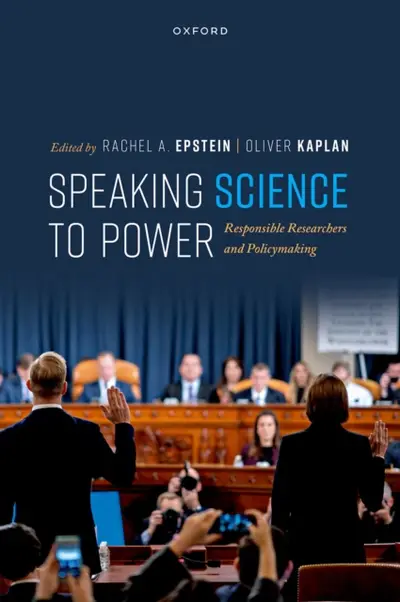
Speaking Science to Power
Responsible Researchers and Policymaking
Price and availability
$29.99
Available in: Andorra, Austria, Australia, Belgium, Bulgaria, Canada, Switzerland, Cyprus, Czechia, Germany, Denmark, Estonia, Spain, Finland, France, United Kingdom, Guernsey, Greece, Croatia, Hungary, Ireland, Isle of Man, Iceland, Italy, Jersey, Japan, Liechtenstein, Lithuania, Luxembourg, Latvia, Monaco, Malta, Netherlands, Norway, Poland, Portugal, Romania, Sweden, Slovenia, Slovakia, San Marino, United States, Vatican City, South Africa
Stores: US, UK, Canada, EU, Australia.
Sign in to buyThe price is re-checked by the server before payment.
For personal use under the eBook licence.
- Format
- DRM
- Not stated by the publisher
- Language
- English
- Publisher
- Oxford University Press
- Published
- 30 September 2024
- ISBN
- 9780198875192
- Subjects
- Research & information: general, Ethical issues & debates, Political science & theory, International relations, Research and information: general, Ethical issues, topics and debates, Political science and theory, International relations
About this book
Science has the potential to do much good. But it can also be misused and cause harm. How can researchers become aware of the risks and share their insights responsibly? This volume gathers a premier group of scholars and practitioners to address cutting-edge dilemmas of "e;responsible policy engagement."e; The authors reflect on their own experiences and provide guidance on how to constructively communicate with policymakers - while also being transparent about the uncertainty and subtleties of the research process. The case studies cover tricky policy engagements on topics ranging from postconflict power-sharing, atrocities prevention, NATO enlargement, economic crises, and business and human rights to counterinsurgency and state-building, census data and polling, and intelligence analysis. To avoid pitfalls, the analyses offer a mix of ethical principles and practical advice, including setting cautionary ethical redlines, reflecting on one's position and values, and describing areas of consensus and degrees of uncertainty. Speaking Science to Power uncovers the temptations scholars may face to share particular results, overgeneralize findings, conceal uncertainty, or curry favor with policymakers, and then urges them to act responsibly.
Bibliographic data © Gardners Books Ltd.