EPUB · English
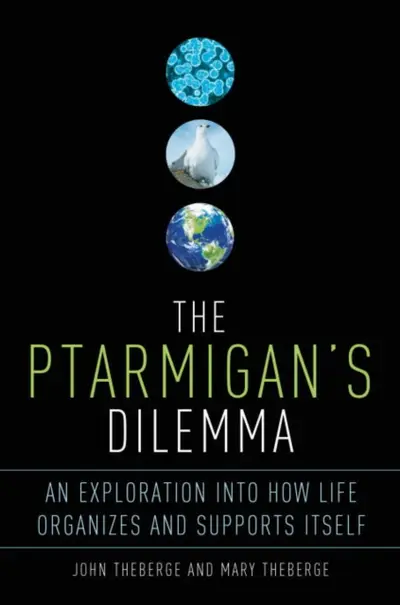
Ptarmigan's Dilemma
An Exploration into How Life Organizes and Supports Itself
Price and availability
$24.99
Available in: Andorra, Austria, Australia, Belgium, Bulgaria, Canada, Switzerland, Cyprus, Czechia, Germany, Denmark, Estonia, Spain, Finland, France, United Kingdom, Guernsey, Greece, Croatia, Hungary, Ireland, Isle of Man, Iceland, Italy, Jersey, Japan, Liechtenstein, Lithuania, Luxembourg, Latvia, Monaco, Malta, Netherlands, Norway, Poland, Portugal, Romania, Sweden, Slovenia, Slovakia, San Marino, United States, Vatican City, South Africa
Stores: US, UK, Canada, EU, Australia.
Sign in to buyThe price is re-checked by the server before payment.
For personal use under the eBook licence.
- Format
- EPUB
- DRM
- Not stated by the publisher
- Language
- English
- Publisher
- McClelland & Stewart
- Published
- 16 March 2010
- ISBN
- 9781551993454
- Subjects
About this book
Winner of the 2010 Lane Anderson Award Drawing on breakthrough research in evolution, genetics, and on their extensive work in the field and lab, wildlife biologists John and Mary Theberge explain for non-scientists the real facts of life. Birds that suddenly grow gall bladders, when their species has none. Moose with antlers so big they encumber their movement through the forest. Butterflies that risk extinction by overwintering en masse. These are just a few stories the Theberges tell in their examination of what the mechanisms of evolution are and how they work. With examples from the very latest discoveries in genetics and ones they have made in their own field work, The Ptarmigan''s Dilemma is a ground-breaking explanation of evolution for non-scientists. By marrying the separate sciences of ecology and genetics, the Theberges paint a picture far richer than either discipline can alone of how, for almost 4 billion years, life on Earth has evolved into the rich diversity that''s under threat today. Along the way, they explain just what "the survival of the fittest" really means, how dramatic evolutionary changes can take place in just one generation, and how our too-little knowledge of or interest in how life on Earth organizes and supports itself is rapidly making us a danger to ourselves. From the Hardcover edition.
Bibliographic data © Gardners Books Ltd.