PDF · English
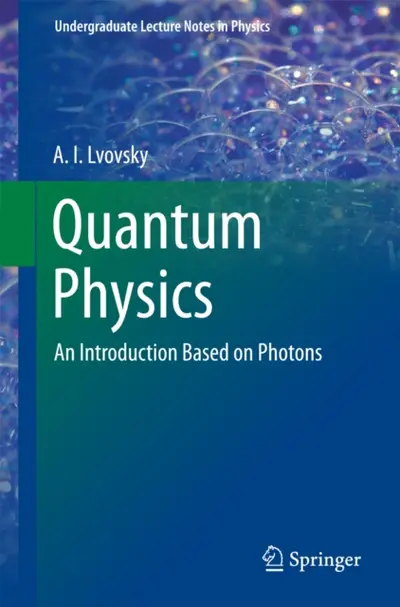
Quantum Physics
An Introduction Based on Photons
Price and availability
$74.99
Available in: Andorra, Austria, Australia, Belgium, Bulgaria, Canada, Switzerland, Cyprus, Czechia, Germany, Denmark, Estonia, Spain, Finland, France, United Kingdom, Guernsey, Greece, Croatia, Hungary, Ireland, Isle of Man, Iceland, Italy, Jersey, Japan, Liechtenstein, Lithuania, Luxembourg, Latvia, Monaco, Malta, Netherlands, Norway, Poland, Portugal, Romania, Sweden, Slovenia, Slovakia, San Marino, United States, Vatican City, South Africa
Stores: US, UK, Canada, EU, Australia.
Sign in to buyThe price is re-checked by the server before payment.
For personal use under the eBook licence.
- Format
- DRM
- Not stated by the publisher
- Language
- English
- Publisher
- Springer Berlin Heidelberg
- Published
- 12 May 2018
- ISBN
- 9783662565841
- Subjects
- Optical physics, Quantum physics (quantum mechanics & quantum field theory), Mathematical theory of computation, Condensed matter physics (liquid state and solid state physics), Optical physics, Quantum physics (quantum mechanics and quantum field theory), Materials science, Mathematical theory of computation
About this book
This textbook is intended to accompany a two-semester course on quantum mechanics for physics students. Along with the traditional material covered in such a course (states, operators, Schrodinger equation, hydrogen atom), it offers in-depth discussion of the Hilbert space, the nature of measurement, entanglement, and decoherence - concepts that are crucial for the understanding of quantum physics and its relation to the macroscopic world, but rarely covered in entry-level textbooks. The book uses a mathematically simple physical system - photon polarization - as the visualization tool, permitting the student to see the entangled beauty of the quantum world from the very first pages. The formal concepts of quantum physics are illustrated by examples from the forefront of modern quantum research, such as quantum communication, teleportation and nonlocality. The author adopts a Socratic pedagogy: The student is guided to develop the machinery ofquantum physics independently by solving sets of carefully chosen problems. Detailed solutions are provided.
Bibliographic data © Gardners Books Ltd.