PDF · English
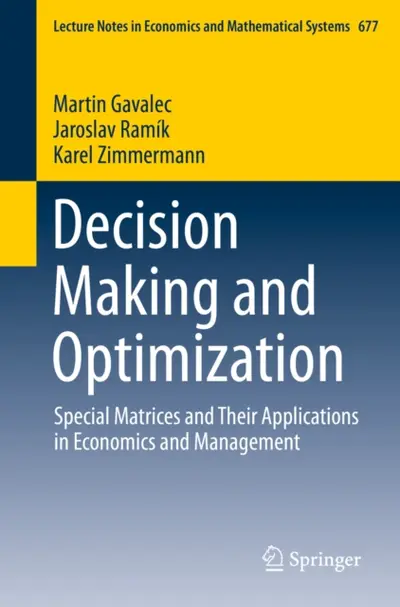
Decision Making and Optimization
Special Matrices and Their Applications in Economics and Management
Price and availability
$60.99
Available in: Andorra, Austria, Australia, Belgium, Bulgaria, Canada, Switzerland, Cyprus, Czechia, Germany, Denmark, Estonia, Spain, Finland, France, United Kingdom, Guernsey, Greece, Croatia, Hungary, Ireland, Isle of Man, Iceland, Italy, Jersey, Japan, Liechtenstein, Lithuania, Luxembourg, Latvia, Monaco, Malta, Netherlands, Norway, Poland, Portugal, Romania, Sweden, Slovenia, Slovakia, San Marino, United States, Vatican City, South Africa
Stores: US, UK, Canada, EU, Australia.
Sign in to buyThe price is re-checked by the server before payment.
For personal use under the eBook licence.
- Format
- DRM
- Not stated by the publisher
- Language
- English
- Publisher
- Springer International Publishing
- Published
- 8 October 2014
- ISBN
- 9783319083230
- Subjects
- Operational research, Optimization, Game theory, Artificial intelligence, Economic theory and philosophy, Management and management techniques, Management decision making, Operational research, Optimization, Engineering: general, Artificial intelligence (AI)
About this book
The book is a benefit for graduate and postgraduate students in the areas of operations research, decision theory, optimization theory, linear algebra, interval analysis and fuzzy sets. The book will also be useful for the researchers in the respective areas. The first part of the book deals with decision making problems and procedures that have been established to combine opinions about alternatives related to different points of view. Procedures based on pairwise comparisons are thoroughly investigated. In the second part we investigate optimization problems where objective functions and constraints are characterized by extremal operators such as maximum, minimum or various triangular norms (t-norms). Matrices in max-min algebra are useful in applications such as automata theory, design of switching circuits, logic of binary relations, medical diagnosis, Markov chains, social choice, models of organizations, information systems, political systems and clustering. The input data in real problems are usually not exact and can be characterized by interval values.
Bibliographic data © Gardners Books Ltd.