PDF · English
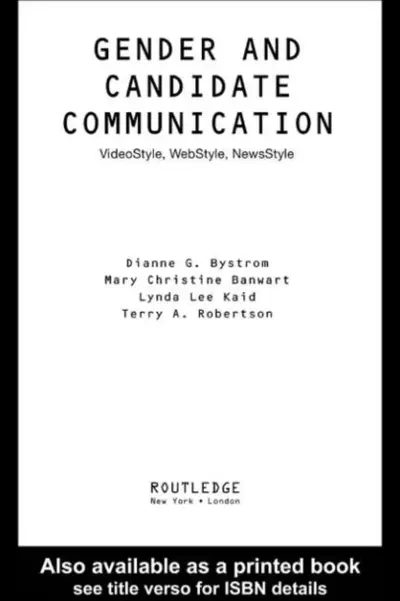
Gender and Candidate Communication
VideoStyle, WebStyle, NewStyle
Price and availability
$66.99
Available in: Andorra, Austria, Australia, Belgium, Bulgaria, Canada, Switzerland, Cyprus, Czechia, Germany, Denmark, Estonia, Spain, Finland, France, United Kingdom, Guernsey, Greece, Croatia, Hungary, Ireland, Isle of Man, Iceland, Italy, Jersey, Japan, Liechtenstein, Lithuania, Luxembourg, Latvia, Monaco, Malta, Netherlands, Norway, Poland, Portugal, Romania, Sweden, Slovenia, Slovakia, San Marino, United States, Vatican City, South Africa
Stores: US, UK, Canada, EU, Australia.
Sign in to buyThe price is re-checked by the server before payment.
For personal use under the eBook licence.
- Format
- DRM
- Not stated by the publisher
- Language
- English
- Publisher
- Taylor & Francis
- Published
- 1 January 2005
- ISBN
- 9781135939427
- Subjects
- Gender studies, gender groups, Political campaigning & advertising, United States of America, USA, Media studies, Gender studies, gender groups, Political campaigning and advertising
About this book
A poll as recently as 2000 revealed that a third of the population thinks there are general characteristics about women that make them less qualified to serve as president. As the public and the media rely on long-held stereotypes, female candidates must focus even harder on the way they want to define their own image through traditional mass media, such as television, and new forms, such as the internet. Gender and Candidate Communication digs deep into the campaigns of the last decade sifting through thousands of ads, websites, and newspaper articles to find out how successful candidates have been in breaking down these gender stereotypes. Among their findings are that female candidates dress more formally, smile more, act tougher when they can, and prefer scare tactics to aggressive attack ads. Gender and Candidate Communication also presents the most comprehensive, systematic method yet for identifying and understanding self-presentation strategies on the web. The internet may be the medium of the future, but Bystrom has found that coverage on the web tends to draw even more heavily on old stereotypes. No close observer of campaigns, gender, or the internet will be able to ignore their findings.
Bibliographic data © Gardners Books Ltd.