EPUB · English
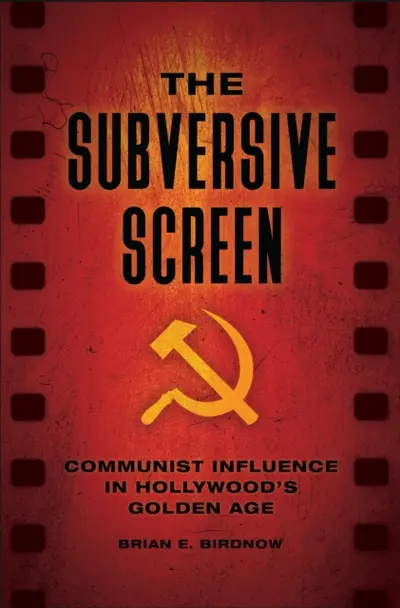
Subversive Screen
Communist Influence in Hollywood''s Golden Age
Price and availability
$54.99
Available in: Andorra, Austria, Australia, Belgium, Bulgaria, Canada, Switzerland, Cyprus, Czechia, Germany, Denmark, Estonia, Spain, Finland, France, United Kingdom, Guernsey, Greece, Croatia, Hungary, Ireland, Isle of Man, Iceland, Italy, Jersey, Japan, Liechtenstein, Lithuania, Luxembourg, Latvia, Monaco, Malta, Netherlands, Norway, Poland, Portugal, Romania, Sweden, Slovenia, Slovakia, San Marino, United States, Vatican City, South Africa
Stores: US, UK, Canada, EU, Australia.
Sign in to buyThe price is re-checked by the server before payment.
For personal use under the eBook licence.
- Format
- EPUB
- DRM
- Not stated by the publisher
- Language
- English
- Publisher
- Bloomsbury Publishing (USA)
- Published
- 17 January 2019
- Pages
- 144
- ISBN
- 9798216151340
- Subjects
- USA, c 1945 to c 1960, Electronic, holographic & video art, Film theory & criticism, Marxism & Communism, United States of America, USA, 3MPQM, Digital, video and new media arts, ATFA, Far-left political ideologies and movements
About this book
A riveting chronicle of Communist Party efforts to propagate Communism in the United States, concurrent with Hollywood's "e;Golden Age"e; of creativity that came to define classical Hollywood cinema.From the Great Depression through World War II, the American Communist Party tried to take control of the motion picture industry. This comprehensive and chronological account of Communist influence in Hollywood surveys the topic from the Popular Front's fight against Fascism during the 1930s to the height of the House Un-American Activities Committee hearings in the late 1940s.Birdnow, an established historian and chronicler of domestic Communism, outlines Communist International's organizational efforts promoting international communism, focusing on the work of Communist political activists such as Willi Munzenberg, a media mogul with an international network; Gerhart Eisler, patron of a Hollywood composer; and Otto Katz, a high-profile publicist of the party line involved in movies in the 1930s and 1940s. The book explores the covert ways in which Hollywood Communists and Soviet sympathizers attempted to tailor movie scripts to suit the Soviet agenda and discusses Communist front groups such as the Hollywood Anti-Nazi League in great detail. Final chapters offer convincing proof that the directors, producers, and screenwriters blacklisted by studios for their possible Communist affiliations, known as the Hollywood Ten, were members of the Communist Party.
Bibliographic data © Gardners Books Ltd.