PDF · English
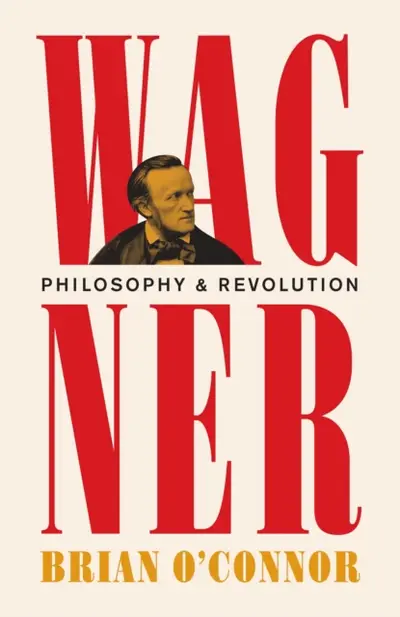
Wagner
Philosophy and Revolution
Price and availability
$40.99
Not available to buy yet.
Available in: Andorra, Austria, Australia, Belgium, Bulgaria, Canada, Switzerland, Cyprus, Czechia, Germany, Denmark, Estonia, Spain, Finland, France, United Kingdom, Guernsey, Greece, Croatia, Hungary, Ireland, Isle of Man, Iceland, Italy, Jersey, Japan, Liechtenstein, Lithuania, Luxembourg, Latvia, Monaco, Malta, Netherlands, Norway, Poland, Portugal, Romania, Sweden, Slovenia, Slovakia, San Marino, United States, Vatican City, South Africa
Stores: US, UK, Canada, EU, Australia.
This title cannot be bought in this store yet: its supplier terms, territorial rights or price are still being confirmed.
For personal use under the eBook licence.
- Format
- DRM
- Not stated by the publisher
- Language
- English
- Publisher
- Princeton University Press
- Published
- 10 November 2026
- ISBN
- 9780691246864
- Subjects
- Germany, German, c 1800 to c 1900, Biography: general, Autobiography: arts & entertainment, Autobiography: historical, political & military, History, European history, Modern history to 20th century: c 1700 to c 1900, Social & political philosophy, Biography: general, Biography: philosophy and social sciences, History, Social and political philosophy
About this book
Wagner as revolutionary philosopher: a new reading of a trilogy of texts written by the composer in the aftermath of the failed Dresden UprisingForced into exile to avoid arrest after taking part in the failed Dresden Uprising in 1849, Richard Wagner turned to philosophical writing, producing in rapid succession three theoretical works. In this compelling study, Brian O'Connor traces Wagner's emergence in these texts as a radical political thinker with a distinctive revolutionary vision. O'Connor describes Wagner's transformation from publicly engaged commentator to active insurrectionist, showing how revolution's failure redirected Wagner's energies toward systematic philosophical reflection. For a crucial period, this theoretical work took precedence over musical composition.At the heart of O'Connor's account is Wagner's philosophical imagination. He explores Wagner's conception of aesthetic spontaneity as a model of individual freedom and his belief in collective artistic creation as the foundation of a liberated society. By situating Wagner's philosophy within the turbulent political and intellectual context of the time, O'Connor challenges its marginalization in previous accounts, restoring it to its proper place in nineteenth-century political thought. He shows how Wagner reworked ideas drawn from the German philosopher Ludwig Feuerbach into an original and provocative form of aesthetic materialism, and examines the interplay between these ideas and Wagner's dramatic works. O'Connor also offers a straightforward treatment of the unavoidable subject of Wagner's antisemitism, as expressed in an essay from 1850 about ';Jewishness' in music.O'Connor argues that Wagner's philosophical writing is not only significant in its own right, but it also offers unique and invaluable insights into his music dramasparticularly the composer's most celebrated work, the Ring cycleilluminating their themes, characters, and revolutionary affinities.
Bibliographic data © Gardners Books Ltd.