EPUB · English
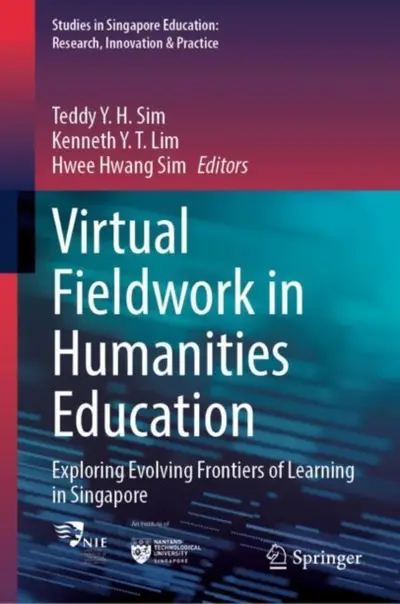
Virtual Fieldwork in Humanities Education
Exploring Evolving Frontiers of Learning in Singapore
Price and availability
$188.99
Available in: Andorra, Austria, Australia, Belgium, Bulgaria, Canada, Switzerland, Cyprus, Czechia, Germany, Denmark, Estonia, Spain, Finland, France, United Kingdom, Guernsey, Greece, Croatia, Hungary, Ireland, Isle of Man, Iceland, Italy, Jersey, Japan, Liechtenstein, Lithuania, Luxembourg, Latvia, Monaco, Malta, Netherlands, Norway, Poland, Portugal, Romania, Sweden, Slovenia, Slovakia, San Marino, United States, Vatican City, South Africa
Stores: US, UK, Canada, EU, Australia.
Sign in to buyThe price is re-checked by the server before payment.
For personal use under the eBook licence.
- Format
- EPUB
- DRM
- Not stated by the publisher
- Language
- English
- Publisher
- Springer Nature Singapore
- Published
- 31 May 2025
- ISBN
- 9789819642007
- Subjects
- Literary studies: general, Library & information sciences, Social research & statistics, Education, Teaching skills & techniques, Educational equipment & technology, computer-aided learning (CAL), Information technology: general issues, Teaching skills and techniques, Educational equipment and technology, computer-aided learning (CAL), Digital Humanities / Computer applications in the arts and humanities, Computer applications in the social and behavioural sciences
About this book
This book is a sequel to the book 'Fieldwork in Humanities Education in Singapore' (Springer, 2021). It addresses some of the queries raised in response to the first book, on the utility of the ‘physical’ or ‘face-to-face’ fieldwork. Combining the opportunities unraveled by new technologies and diverse demands to actualize learning, this book showcases a variety of engagements in virtual fieldwork. These demonstrate current developments in the deployment of fieldwork in teaching and learning in Singapore, as well as discuss pertinent interacting issues in technology that arise. The chapters in this book informs evidence-based recommendations for – inter alia – the integration of virtual reality (VR) systems into place-based curricula.The drive towards better and more advanced technology is a relentless trend. At the same time, the still evolving nature of frontier technologies and their adoption in the education sector entail a constant re-definition of their primary fields and resulting applications. This book contributes to the discussion and analysis of this ongoing process.
Bibliographic data © Gardners Books Ltd.