PDF · English
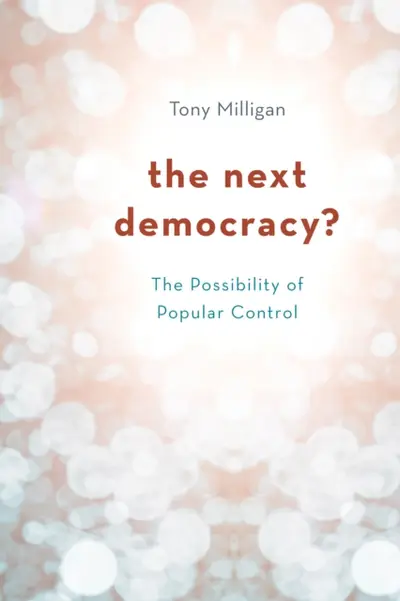
Next Democracy?
The Possibility of Popular Control
Price and availability
$53.99
Available in: Andorra, Austria, Australia, Belgium, Bulgaria, Canada, Switzerland, Cyprus, Czechia, Germany, Denmark, Estonia, Spain, Finland, France, United Kingdom, Guernsey, Greece, Croatia, Hungary, Ireland, Isle of Man, Iceland, Italy, Jersey, Japan, Liechtenstein, Lithuania, Luxembourg, Latvia, Monaco, Malta, Netherlands, Norway, Poland, Portugal, Romania, Sweden, Slovenia, Slovakia, San Marino, United States, Vatican City, South Africa
Stores: US, UK, Canada, EU, Australia.
Sign in to buyThe price is re-checked by the server before payment.
For personal use under the eBook licence.
- Format
- DRM
- Not stated by the publisher
- Language
- English
- Publisher
- Bloomsbury Publishing (USA)
- Published
- 18 July 2016
- Pages
- 208
- ISBN
- 9781783480661
- Subjects
- Social & political philosophy, Political science & theory, Political structures: democracy, Civil rights & citizenship, Political science and theory, Political structures / systems: democracy, JPVC, QDTS
About this book
Representative democracy has long been problematic and subject to erosion through the introduction of components of direct democracy (referenda, voter initiatives and systems of recall). Following the increase of direct action across the world, through the Occupy movement and the rise of new populist parties championing greater citizen inclusion in decision making, many are considering whether the hierarchical system of political control might have had its day. But what might be the alternative, next democracy? This book considers the viability of a populist conception of democratic organization, which puts power into the hands of ordinary citizens. Examining contemporary and classic theory to contextualize the critique of existing systems, the book goes on to explore alternative arrangements tested out by activists, eco-protestors and anti-capitalists - from the recent Occupy agenda to Gandhi's experiments in alternative living. Milligan confronts the practical challenges posed by these systems of direct democracy and discusses the considerable difficulties of scaling up and sustaining them in state-level contexts. Whilst the book concedes that such concerns are genuine, it argues that a theory of generalized direct democracy can shake off its utopian aspirations and become a legitimate alternative for the future.
Bibliographic data © Gardners Books Ltd.