PDF · English
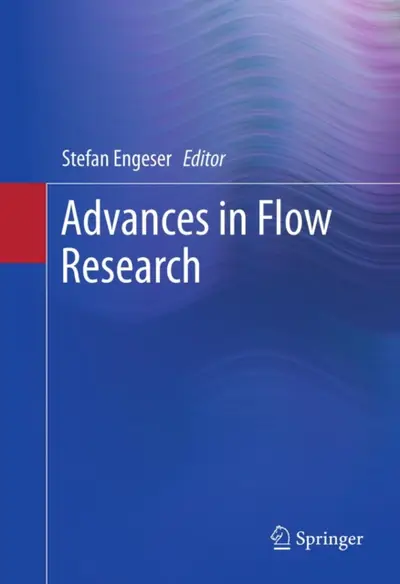
Advances in Flow Research
Price and availability
$107.99
Available in: Andorra, Austria, Australia, Belgium, Bulgaria, Canada, Switzerland, Cyprus, Czechia, Germany, Denmark, Estonia, Spain, Finland, France, United Kingdom, Guernsey, Greece, Croatia, Hungary, Ireland, Isle of Man, Iceland, Italy, Jersey, Japan, Liechtenstein, Lithuania, Luxembourg, Latvia, Monaco, Malta, Netherlands, Norway, Poland, Portugal, Romania, Sweden, Slovenia, Slovakia, San Marino, United States, Vatican City, South Africa
Stores: US, UK, Canada, EU, Australia.
Sign in to buyThe price is re-checked by the server before payment.
For personal use under the eBook licence.
- Format
- DRM
- Not stated by the publisher
- Language
- English
- Publisher
- Springer New York
- Published
- 20 March 2012
- ISBN
- 9781461423591
- Subjects
- The self, ego, identity, personality, Psychology: the self, ego, identity, personality
About this book
The concept of Flow was first explained by Csikszentmihalyi (1975), described as an "e;optimal experience,"e; he noted that artists were entirely caught up in their projects, working feverishly to finish them and then lose all interest in their work after completion. The incentive lies in the act of creativity itself. The person feels optimally challenged while totally immersed in the activity. At the heart of flow research is the motivational aspect of this experience. Flow motivates people to carry out certain activities repeatedly, seeking a challenge in the act and looking to improve their skills and abilities. In this book, this motivational aspect will be imbedded in and related to other theories of (intrinsic) motivation and empirical work on flow and performance. The book provides a review of the current flow research, with a focus on rigorous analysis on methodology. The author takes the time to present methodological aspects in flow research to qualify empirical work. In addition, this volume presents neuropsychological considerations and empirical correlates of flow experiences. The work also describes various theoretical integrations of the different paths being taken within the field of flow research. It presents what has been learned since the beginning of flow research, what is still open, and how the mission to understand and foster flow experience research should continue.
Bibliographic data © Gardners Books Ltd.