PDF · English
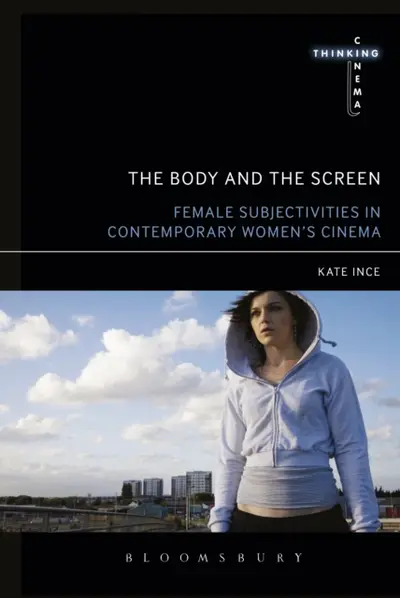
Body and the Screen
Female Subjectivities in Contemporary Women’s Cinema
Price and availability
$43.99
Available in: Andorra, Austria, Australia, Belgium, Bulgaria, Canada, Switzerland, Cyprus, Czechia, Germany, Denmark, Estonia, Spain, Finland, France, United Kingdom, Guernsey, Greece, Croatia, Hungary, Ireland, Isle of Man, Iceland, Italy, Jersey, Japan, Liechtenstein, Lithuania, Luxembourg, Latvia, Monaco, Malta, Netherlands, Norway, Poland, Portugal, Romania, Sweden, Slovenia, Slovakia, San Marino, United States, Vatican City, South Africa
Stores: US, UK, Canada, EU, Australia.
Sign in to buyThe price is re-checked by the server before payment.
For personal use under the eBook licence.
- Format
- DRM
- Not stated by the publisher
- Language
- English
- Publisher
- Bloomsbury Publishing (USA)
- Published
- 12 January 2017
- Pages
- 224
- ISBN
- 9781623566265
- Subjects
- c 1990 to c 2000, 21st century, Individual film directors, film-makers, Philosophy: aesthetics, Feminism & feminist theory, 3MPQZ, 3MR, ATFB, JBSF11, QDTN
About this book
Winner of the British Association of Film, Television and Screen Studies Best Book Prize 2018Since the 1980s the number of women regularly directing films has increased significantly in most Western countries; in France, Claire Denis and Catherine Breillat have joined Agnes Varda in gaining international renown, while British directors Lynne Ramsay and Andrea Arnold have forged award-winning careers in feature film. This new volume in the "e;Thinking Cinema"e; series draws on feminist philosophers and theorists from Simone de Beauvoir on to offer readings of a range of the most important and memorable of these films from the 1990s and 2000s, focusing as it does so on how the films convey women's lives and identities. Mainstream entertainment cinema traditionally distorts the representation of women, objectifying their bodies, minimizing their agency, and avoiding the most important questions about how cinema can "e;do justice"e; to female subjectivity. Kate Ince suggests that the films of independent women directors are progressively redressing the balance, reinvigorating both the narratives and the formal ambitions of European cinema. Ince uses feminist philosophers to interpret such films as Sex Is Comedy, Morvern Callar, White Material, and Fish Tank anew, suggesting that a philosophical understanding of female subjectivity as embodied and ethical should underpin future feminist film study.
Bibliographic data © Gardners Books Ltd.