EPUB · English
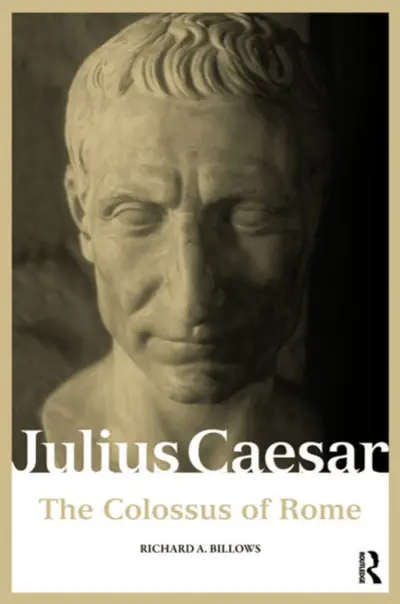
Julius Caesar
The Colossus of Rome
Price and availability
$59.99
Available in: Andorra, Austria, Australia, Belgium, Bulgaria, Canada, Switzerland, Cyprus, Czechia, Germany, Denmark, Estonia, Spain, Finland, France, United Kingdom, Guernsey, Greece, Croatia, Hungary, Ireland, Isle of Man, Iceland, Italy, Jersey, Japan, Liechtenstein, Lithuania, Luxembourg, Latvia, Monaco, Malta, Netherlands, Norway, Poland, Portugal, Romania, Sweden, Slovenia, Slovakia, San Marino, United States, Vatican City, South Africa
Stores: US, UK, Canada, EU, Australia.
Sign in to buyThe price is re-checked by the server before payment.
For personal use under the eBook licence.
- Format
- EPUB
- DRM
- Not stated by the publisher
- Language
- English
- Publisher
- Taylor & Francis
- Published
- 28 November 2008
- ISBN
- 9781134318322
- Subjects
- Ancient Rome, Ancient history: to c 500 CE, Classical history / classical civilisation, Ancient Rome, Biography: historical, political and military, Ancient history, European history: the Romans
About this book
Julius Caesar offers a lively, engaging, and thoroughly up-to-date account of Caesar's life and times. Richard Billows' dynamic and fast paced narrative offers an imaginative recounting of actions and events, providing the ideal introduction to Julius Caesar for general readers and students of classics and ancient history. The book is not just a biography of Caesar, but an historical account and explanation of the decline and fall of the Roman Republican governing system, in which Caesar played a crucial part. To understand Caesar's life and role, it is necessary to grasp the political, social and economic problems Rome was grappling with, and the deep divisions within Roman society that came from them. Caesar has been seen variously as a mere opportunist, a power-hungry autocrat, an arrogant aristocrat disdaining rivals, a traditional Roman noble politician who stumbled into civil war and autocracy thanks to being misunderstood by his rivals, and even as the ideal man and pattern of all virtues. Richard A. Billows argues that such portrayals fail to consider the universal testimony of our ancient sources that Roman political life was divided in Caesar's time into two great political tendencies, called "e;optimates"e; and "e;populares"e; in the sources, of which Caesar came to be the leader of one: the "e;popularis"e; faction.Billows suggests that it is only when we see Caesar as the leader of a great political and social movement, that had been struggling with its rival movement for decades and had been several times violently repressed in the course of that struggle, that we can understand how and why Caesar came to fight and win a civil war, and bring the traditional governing system of Rome to an end.
Bibliographic data © Gardners Books Ltd.