PDF · English
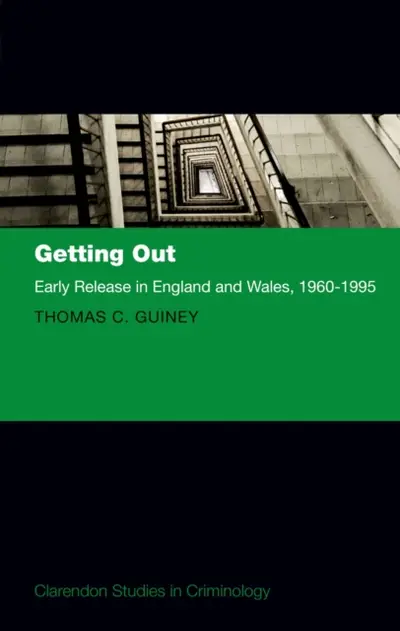
Getting Out
Early Release in England and Wales, 1960 - 1995
Price and availability
$85.99
Available in: Andorra, Austria, Australia, Belgium, Bulgaria, Canada, Switzerland, Cyprus, Czechia, Germany, Denmark, Estonia, Spain, Finland, France, United Kingdom, Guernsey, Greece, Croatia, Hungary, Ireland, Isle of Man, Iceland, Italy, Jersey, Japan, Liechtenstein, Lithuania, Luxembourg, Latvia, Monaco, Malta, Netherlands, Norway, Poland, Portugal, Romania, Sweden, Slovenia, Slovakia, San Marino, United States, Vatican City, South Africa
Stores: US, UK, Canada, EU, Australia.
Sign in to buyThe price is re-checked by the server before payment.
For personal use under the eBook licence.
- Format
- DRM
- Not stated by the publisher
- Language
- English
- Publisher
- Oxford University Press
- Published
- 12 July 2018
- ISBN
- 9780192525567
- Subjects
- England, Wales, c 1960 to c 1970, Penology & punishment, Prisons, Rehabilitation of offenders, Law & society, Penology and punishment, Law and society, sociology of law
About this book
Getting Out offers the first systematic account of the evolution of early release as a public policy concern in England and Wales between 1960 and 1995. At a time when public discourse on crime has focused, to a significant degree, upon the powers of the police and the sentence of the court this book seeks to turn current debate on its head and examine the circumstances in which policy makers have found it desirable to reduce the custodial element of a prison sentence and return prisoners to the community. Drawing upon an extensive period of archival research, and interviews with key decision-makers, this book considers three defining periods of reform that illuminate the complex ideas, trade-offs, and moments of political controversy that have shaped this secretive and little understood area of penal policy. The book argues that early release is inherently bound up with prevailing societal justifications for punishment and the appropriate use of imprisonment within our liberal democratic system. It draws attention to the uneasy constitutional balance of power between the judiciary and the executive, and reflects upon the administrative task of governing large captive populations where the hopes and expectations of inmates do not always align with the interests of prison authorities or the community at large. In so doing, Getting Out challenges widespread assumptions about penal change and shows how government policy has been shaped by the legacy of past political choices, the organisation of central government departments and the fluid balance of power within Whitehall.
Bibliographic data © Gardners Books Ltd.