EPUB · English
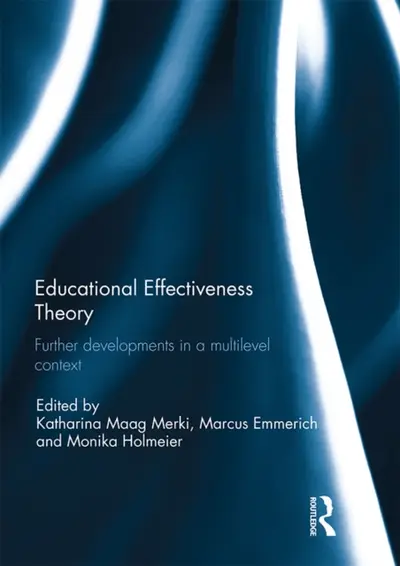
Educational Effectiveness Theory
Further developments in a multilevel context
Price and availability
$67.99
Available in: Andorra, Austria, Australia, Belgium, Bulgaria, Canada, Switzerland, Cyprus, Czechia, Germany, Denmark, Estonia, Spain, Finland, France, United Kingdom, Guernsey, Greece, Croatia, Hungary, Ireland, Isle of Man, Iceland, Italy, Jersey, Japan, Liechtenstein, Lithuania, Luxembourg, Latvia, Monaco, Malta, Netherlands, Norway, Poland, Portugal, Romania, Sweden, Slovenia, Slovakia, San Marino, United States, Vatican City, South Africa
Stores: US, UK, Canada, EU, Australia.
Sign in to buyThe price is re-checked by the server before payment.
For personal use under the eBook licence.
- Format
- EPUB
- DRM
- Not stated by the publisher
- Language
- English
- Publisher
- Taylor & Francis
- Published
- 11 October 2018
- ISBN
- 9781351863841
- Subjects
- Education, Philosophy & theory of education, Educational psychology, Organization & management of education, Higher & further education, tertiary education, Research methods / methodology, Philosophy and theory of education, Educational strategies and policy
About this book
Despite the advances in educational effectiveness theory and methodology in the last 20 years, important questions and issues remain unresolved. In particular, existing theoretical frameworks of educational effectiveness are only able to describe the interrelationship among factors at the system, school, classroom, and student levels and their cross-level interdependency in a very general manner. Additionally, although a large number of studies provide empirical evidence of the impact of single factors and factor constellations on student learning, the embedding of the empirically identified results in theoretical models of educational effectiveness has to be carried out more systematically in order to develop more elaborated theories of educational effectiveness. The aim of this book is to contribute to the advancement of educational effectiveness theory by discussing different strategies: including alternative theoretical models to understand educational in/effectiveness, extending the methodology to analyze processes and mechanisms of educational in/effectiveness, analyzing differential effects of processes and instruments on educational in/effectiveness, carrying out complex multivariate analyses considering manifest and latent variables, and combining theory and practice in real school situations. Taken together, the strategies presented in this book make it clear that the advancement of educational effectiveness theory depends on the advancement of educational effectiveness methodology, or in other words: from theory to methodology and from empirical evidence back to theory. This book was originally published as a special issue of School Effectiveness and School Improvement.
Bibliographic data © Gardners Books Ltd.