PDF · Spanish
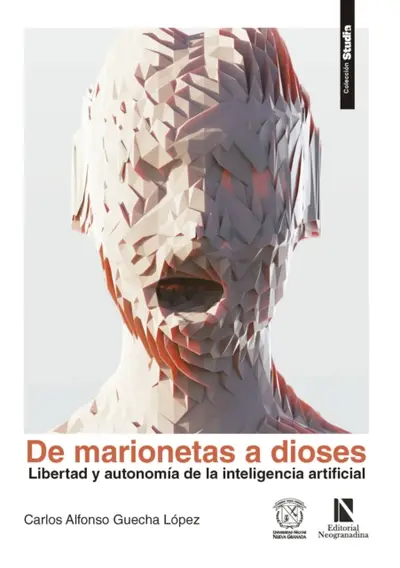
De marionetas a dioses
Libertad y autonomia de la inteligencia artificial
Price and availability
$3.99
Available in: Andorra, Austria, Australia, Belgium, Bulgaria, Canada, Switzerland, Cyprus, Czechia, Germany, Denmark, Estonia, Spain, Finland, France, United Kingdom, Guernsey, Greece, Croatia, Hungary, Ireland, Isle of Man, Iceland, Italy, Jersey, Japan, Liechtenstein, Lithuania, Luxembourg, Latvia, Monaco, Malta, Netherlands, Norway, Poland, Portugal, Romania, Sweden, Slovenia, Slovakia, San Marino, United States, Vatican City, South Africa
Stores: US, UK, Canada, EU, Australia.
Sign in to buyThe price is re-checked by the server before payment.
For personal use under the eBook licence.
- Format
- DRM
- Not stated by the publisher
- Language
- Spanish
- Publisher
- Hipertexto S.A.S
- Published
- 1 September 2026
- ISBN
- 9786287758988
- Subjects
- Physics, Physics
About this book
ResumenEl libro se organiza alrededor de dos preguntas centrales: si las maquinas pueden ser libres y hasta que punto esa posible libertad afectaria la libertad humana. Desde ahi, analiza un mundo mar cado por la automatizacion que ya influye en decisiones sociales, economicas y politicas. La obra se enfoca en la ia de proposito general y en agentes roboticos basados en grandes modelos de lenguaje y aprendizaje por refuerzo. Su enfoque es doble: por un lado, propone criterios para identificar, atribuir y proteger una eventual libertad artificial; por el otro, examina sus limites y riesgos. Para hacerlo, reconstruye distintas ideas de libertad y las usa para estudiar la autonomia algoritmica y su relacion con los derechos fundamentales. Entre sus principales aportes destacan salvaguardas como la transparencia, la explicacion, la auditabi lidad y la intervencion humana. En conjunto, propone un marco para regular una ia autonoma de forma compatible con la demo cracia y la libertad humana. AbstractThe book is organized around two central questions: whether machines can be free, and to what extent that potential freedom would affect human freedom. From there, it analyzes a world sha ped by automation that is already influencing social, economic, and political decisions. The work focuses on general-purpose AI and robotic agents based on large language models and reinforce ment learning. Its approach is twofold: on the one hand, it propo ses criteria for identifying, attributing, and protecting potential artificial freedom; on the other, it examines its limits and risks. To this end, it reconstructs various conceptions of freedom and uses them to study algorithmic autonomy and its relationship to fundamental rights. Among its key contributions are safeguards such as transparency, explainability, auditability, and human in tervention. Taken together, it proposes a framework for regulating autonomous ai in a way that is compatible with democracy and human freedom.
Bibliographic data © Gardners Books Ltd.