PDF · English
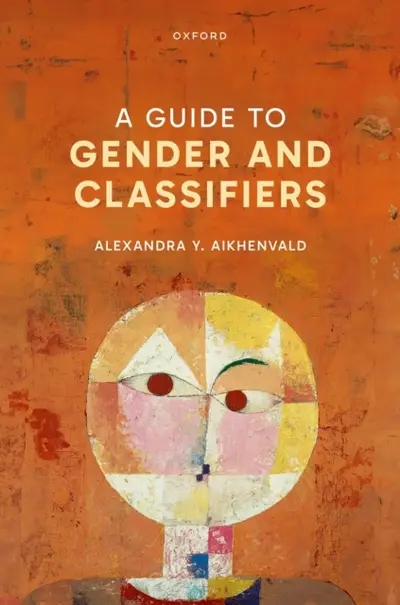
Guide to Gender and Classifiers
Price and availability
$118.99
Available in: Andorra, Austria, Australia, Belgium, Bulgaria, Canada, Switzerland, Cyprus, Czechia, Germany, Denmark, Estonia, Spain, Finland, France, United Kingdom, Guernsey, Greece, Croatia, Hungary, Ireland, Isle of Man, Iceland, Italy, Jersey, Japan, Liechtenstein, Lithuania, Luxembourg, Latvia, Monaco, Malta, Netherlands, Norway, Poland, Portugal, Romania, Sweden, Slovenia, Slovakia, San Marino, United States, Vatican City, South Africa
Stores: US, UK, Canada, EU, Australia.
Sign in to buyThe price is re-checked by the server before payment.
For personal use under the eBook licence.
- Format
- DRM
- Not stated by the publisher
- Language
- English
- Publisher
- Oxford University Press
- Published
- 12 February 2025
- ISBN
- 9780192608956
- Subjects
- Sociolinguistics, Grammar, syntax & morphology, Social & cultural anthropology, ethnography, Sociolinguistics, Grammar, syntax and morphology, Social and cultural anthropology
About this book
This book explores the range of noun categorization devices found in the languages of the world, from the extensive systems of numeral classifiers in Southeast Asia to the highly grammaticalized gender agreement classes in Indo-European languages. Almost all languages use some type of noun categorization device in their grammar, with the most widespread being linguistic gender, whereby nouns are classified based on core semantic properties such as sex, animacy, humanness, or shape and size. Numeral classifiers are also common, and classify a noun in terms of its inherent nature, animacy, shape, and form, accompanied by a numeral or a quantifier. Other types of noun categorization devices include noun classifiers, possessive classifiers, verbal classifiers, and a number of rarer types such as locative and deictic classifiers. In this volume, Alexandra Aikhenvald investigates all facets of these nominal categorization systems, from their form and distribution to their origins, development, and loss. Noun categorization devices provide unique insights into how people categorize the world through the language: in one language, a human might be classified in terms of orientation, hence as 'vertical', in another as male or female, and in another as simply 'animate' or even 'rational'. They also change as society changes, reflecting the ways in which language and social environment are integrated into a single whole.
Bibliographic data © Gardners Books Ltd.