PDF · English
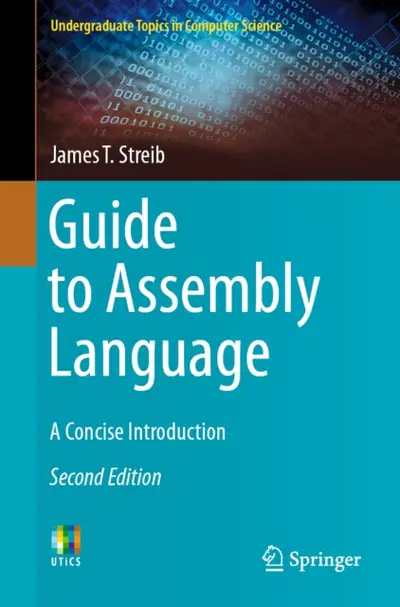
Guide to Assembly Language
A Concise Introduction
Price and availability
$60.99
Available in: Andorra, Austria, Australia, Belgium, Bulgaria, Canada, Switzerland, Cyprus, Czechia, Germany, Denmark, Estonia, Spain, Finland, France, United Kingdom, Guernsey, Greece, Croatia, Hungary, Ireland, Isle of Man, Iceland, Italy, Jersey, Japan, Liechtenstein, Lithuania, Luxembourg, Latvia, Monaco, Malta, Netherlands, Norway, Poland, Portugal, Romania, Sweden, Slovenia, Slovakia, San Marino, United States, Vatican City, South Africa
Stores: US, UK, Canada, EU, Australia.
Sign in to buyThe price is re-checked by the server before payment.
For personal use under the eBook licence.
- Format
- DRM
- Not stated by the publisher
- Language
- English
- Publisher
- Springer International Publishing
- Published
- 23 January 2020
- ISBN
- 9783030356392
- Subjects
- Compilers, Computer architecture & logic design, Compilers and interpreters, Computer architecture and logic design
About this book
This concise guide is designed to enable the reader to learn how to program in assembly language as quickly as possible. Through a hands-on programming approach, readers will also learn about the architecture of the Intel processor, and the relationship between high-level and low-level languages.This updated second edition has been expanded with additional exercises, and enhanced with new material on floating-point numbers and 64-bit processing.Topics and features: provides guidance on simplified register usage, simplified input/output using C-like statements, and the use of high-level control structures; describes the implementation of control structures, without the use of high-level structures, and often with related C program code; illustrates concepts with one or more complete program; presents review summaries in each chapter, together with a variety of exercises, from short-answer questions to programming assignments; covers selection and iteration structures, logic,shift, arithmetic shift, rotate, and stack instructions, procedures and macros, arrays, and strings; includes an introduction to floating-point instructions and 64-bit processing; examines machine language from a discovery perspective, introducing the principles of computer organization.A must-have resource for undergraduate students seeking to learn the fundamentals necessary to begin writing logically correct programs in a minimal amount of time, this work will serve as an ideal textbook for an assembly language course, or as a supplementary text for courses on computer organization and architecture. The presentation assumes prior knowledge of the basics of programming in a high-level language such as C, C++, or Java.
Bibliographic data © Gardners Books Ltd.