PDF · English
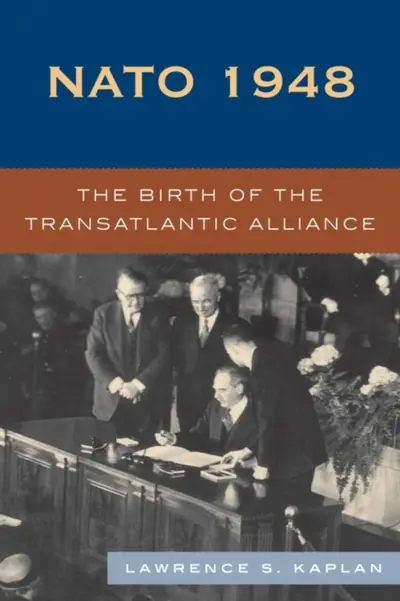
NATO 1948
The Birth of the Transatlantic Alliance
Price and availability
$53.99
Available in: Andorra, Austria, Australia, Belgium, Bulgaria, Canada, Switzerland, Cyprus, Czechia, Germany, Denmark, Estonia, Spain, Finland, France, United Kingdom, Guernsey, Greece, Croatia, Hungary, Ireland, Isle of Man, Iceland, Italy, Jersey, Japan, Liechtenstein, Lithuania, Luxembourg, Latvia, Monaco, Malta, Netherlands, Norway, Poland, Portugal, Romania, Sweden, Slovenia, Slovakia, San Marino, United States, Vatican City, South Africa
Stores: US, UK, Canada, EU, Australia.
Sign in to buyThe price is re-checked by the server before payment.
For personal use under the eBook licence.
- Format
- DRM
- Not stated by the publisher
- Language
- English
- Publisher
- Bloomsbury Publishing (USA)
- Published
- 21 June 2007
- Pages
- 286
- ISBN
- 9781461640264
- Subjects
- USA, c 1945 to c 1960, General & world history, History of the Americas, Second World War, International relations, Diplomacy, International institutions, Defence strategy, planning & research, Treaties & other sources of international law, Geographical discovery & exploration, United States of America, USA, 3MPQM, International relations, Diplomacy, International institutions / intergovernmental organizations, Military and defence strategy, Public international law: treaties and other sources, NHB, NHK, NHWR7, Geographical discovery and exploration
About this book
This compelling history brings to life the watershed year of 1948, when the United States reversed its long-standing position of political and military isolation from Europe and agreed to an "e;entangling alliance"e; with ten European nations. Not since 1800, when the United States ended its alliance with France, had the nation made such a commitment. The historic North Atlantic Treaty was signed on April 4, 1949, but the often-contentious negotiations stretched throughout the preceding year. Lawrence S. Kaplan, the leading historian of NATO, traces the tortuous and dramatic process, which struggled to reconcile the conflicting concerns on the part of the future partners. Although the allies could agree on the need to cope with the threat of Soviet-led Communism and on the vital importance of an American association with a unified Europe, they differed over the means of achieving these ends. The United States had to contend with domestic isolationist suspicions of Old World intentions, the military's worries about over extension of the nation's resources, and the apparent incompatibility of the projected treaty with the UN charter. For their part, Europeans had to be convinced that American demands to abandon their traditions would provide the sense of security that economic and political recovery from World War II required. Kaplan brings to life the colorful diplomats and politicians arrayed on both sides of the debate. The end result was a remarkably durable treaty and alliance that has linked the fortunes of America and Europe for over fifty years. Despite differences that have persisted and occasionally flared over the past fifty years, NATO continues to bind America and Europe in the twenty-first century. Kaplan's detailed and lively account draws on a wealth of primary sources-newspapers, memoirs, and diplomatic documents-to illuminate how the United States came to assume international obligations it had scrupulously avoided for the previous 150 years.
Bibliographic data © Gardners Books Ltd.