PDF · English
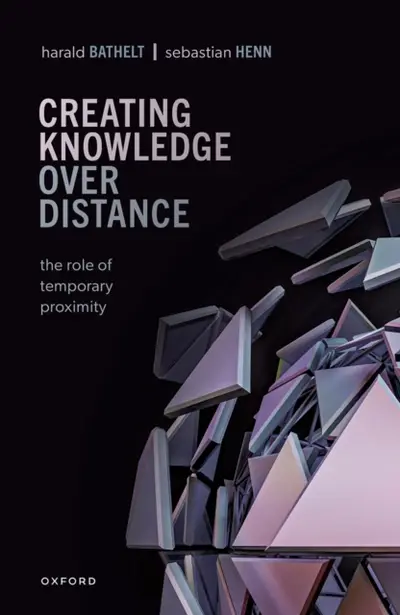
Creating Knowledge over Distance
The Role of Temporary Proximity
Price and availability
$33.99
Available in: Andorra, Austria, Australia, Belgium, Bulgaria, Canada, Switzerland, Cyprus, Czechia, Germany, Denmark, Estonia, Spain, Finland, France, United Kingdom, Guernsey, Greece, Croatia, Hungary, Ireland, Isle of Man, Iceland, Italy, Jersey, Japan, Liechtenstein, Lithuania, Luxembourg, Latvia, Monaco, Malta, Netherlands, Norway, Poland, Portugal, Romania, Sweden, Slovenia, Slovakia, San Marino, United States, Vatican City, South Africa
Stores: US, UK, Canada, EU, Australia.
Sign in to buyThe price is re-checked by the server before payment.
For personal use under the eBook licence.
- Format
- DRM
- Not stated by the publisher
- Language
- English
- Publisher
- Oxford University Press
- Published
- 26 September 2025
- ISBN
- 9780192592064
- Subjects
- Business strategy, Business innovation, International business, Business strategy, Business innovation, International business
About this book
Creating Knowledge over Distance shows that economic knowledge creation fundamentally depends on, benefits from, and is structured by temporary geographical proximity - that is, by economic actors meeting in person or interacting in a co-present context to discuss business opportunities, problems and solutions are face to face. During the Covid-19 pandemic, personal meetings often had to be reduced or were replaced by virtual meetings, leading many observers to assume a fundamental reconfiguration of economic life in the future as face-to-face interaction may be substituted by virtual interaction through the use of new information and communication technologies. While communication patterns certainly changed during this period, this book demonstrates that the face-to-face meetings the authors investigate across a sequence of 11 chapters with different knowledge-creation contexts are unlikely to be fully substituted by distant interactions - and may even become more important over time. The book develops the argument by systematically analyzing three configurations of knowledge transfers over distance: (1) international community gatherings, such as trade fairs, delegation travel, conventions and conferences, (2) mobile business practices, including intra-firm business coordination, inter-firm projects, producer-user meetings, and corporate expansions/inter-firm negotiations, as well as (3) transnational networks, related to transnational corporations and transnational migrant firms (including new transnational firms/new Argonauts and transnational family networks).
Bibliographic data © Gardners Books Ltd.