PDF · English
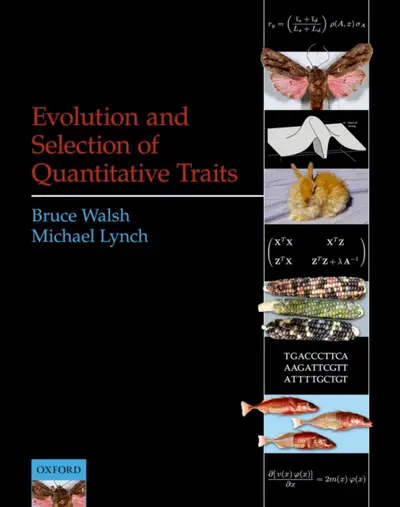
Evolution and Selection of Quantitative Traits
Price and availability
$151.99
Available in: Andorra, Austria, Australia, Belgium, Bulgaria, Canada, Switzerland, Cyprus, Czechia, Germany, Denmark, Estonia, Spain, Finland, France, United Kingdom, Guernsey, Greece, Croatia, Hungary, Ireland, Isle of Man, Iceland, Italy, Jersey, Japan, Liechtenstein, Lithuania, Luxembourg, Latvia, Monaco, Malta, Netherlands, Norway, Poland, Portugal, Romania, Sweden, Slovenia, Slovakia, San Marino, United States, Vatican City, South Africa
Stores: US, UK, Canada, EU, Australia.
Sign in to buyThe price is re-checked by the server before payment.
For personal use under the eBook licence.
- Format
- DRM
- Not stated by the publisher
- Language
- English
- Publisher
- Oxford University Press
- Published
- 21 June 2018
- ISBN
- 9780192566645
- Subjects
- Evolution, DNA & Genome, Evolution / Evolutionary biology, Genetics (non-medical), Computational biology / bioinformatics
About this book
Quantitative traits-be they morphological or physiological characters, aspects of behavior, or genome-level features such as the amount of RNA or protein expression for a specific gene-usually show considerable variation within and among populations. Quantitative genetics, also referred to as the genetics of complex traits, is the study of such characters and is based on mathematical models of evolution in which many genes influence the trait and in which non-genetic factors may also be important. Evolution and Selection of Quantitative Traits presents a holistic treatment of the subject, showing the interplay between theory and data with extensive discussions on statistical issues relating to the estimation of the biologically relevant parameters for these models. Quantitative genetics is viewed as the bridge between complex mathematical models of trait evolution and real-world data, and the authors have clearly framed their treatment as such. This is the second volume in a planned trilogy that summarizes the modern field of quantitative genetics, informed by empirical observations from wide-ranging fields (agriculture, evolution, ecology, and human biology) as well as population genetics, statistical theory, mathematical modeling, genetics, and genomics. Whilst volume 1 (1998) dealt with the genetics of such traits, the main focus of volume 2 is on their evolution, with a special emphasis on detecting selection (ranging from the use of genomic and historical data through to ecological field data) and examining its consequences.
Bibliographic data © Gardners Books Ltd.