PDF · English
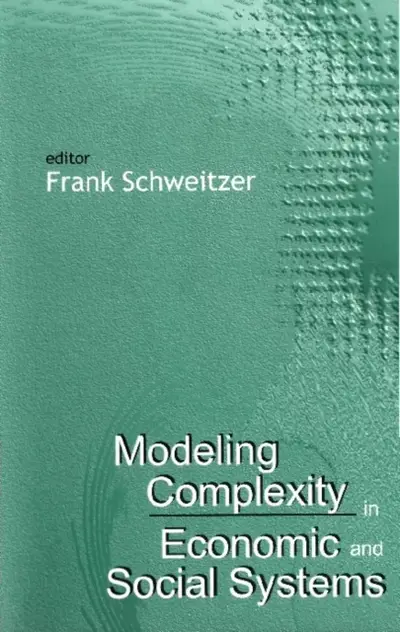
Modeling Complexity In Economic And Social Systems
Price and availability
$72.99
Available in: Andorra, Austria, Australia, Belgium, Bulgaria, Canada, Switzerland, Cyprus, Czechia, Germany, Denmark, Estonia, Spain, Finland, France, United Kingdom, Guernsey, Greece, Croatia, Hungary, Ireland, Isle of Man, Iceland, Italy, Jersey, Japan, Liechtenstein, Lithuania, Luxembourg, Latvia, Monaco, Malta, Netherlands, Norway, Poland, Portugal, Romania, Sweden, Slovenia, Slovakia, San Marino, United States, Vatican City, South Africa
Stores: US, UK, Canada, EU, Australia.
Sign in to buyThe price is re-checked by the server before payment.
For personal use under the eBook licence.
- Format
- DRM
- Not stated by the publisher
- Language
- English
- Publisher
- World Scientific Publishing Company
- Published
- 9 December 2002
- Pages
- 404
- ISBN
- 9789814488358
- Subjects
- Social theory, Economic theory & philosophy, Economic systems & structures, Mathematical modelling, Nonlinear science, Social theory, Economic theory and philosophy, Economic systems and structures, Mathematical modelling, Nonlinear science
About this book
Economics and the social sciences are, in fact, the "e;hard"e; sciences, as Herbert Simon argued, because the complexity of the problems dealt with cannot simply be reduced to analytically solvable models or decomposed into separate subprocesses. Nevertheless, in recent years, the emerging interdisciplinary "e;sciences of complexity"e; have provided new methods and tools for tackling these problems, ranging from complex data analysis to sophisticated computer simulations. In particular, advanced methods developed in the natural sciences have recently also been applied to social and economic problems.The twenty-one chapters of this book reflect this modern development from various modeling perspectives (such as agent-based models, evolutionary game theory, reinforcement learning and neural network techniques, time series analysis, non-equilibrium macroscopic dynamics) and for a broad range of socio-economic applications (market dynamics, technological evolution, spatial dynamics and economic growth, decision processes, and agent societies). They jointly demonstrate a shift of perspective in economics and the social sciences that is allowing a new outlook in this field to emerge.
Bibliographic data © Gardners Books Ltd.