PDF · English
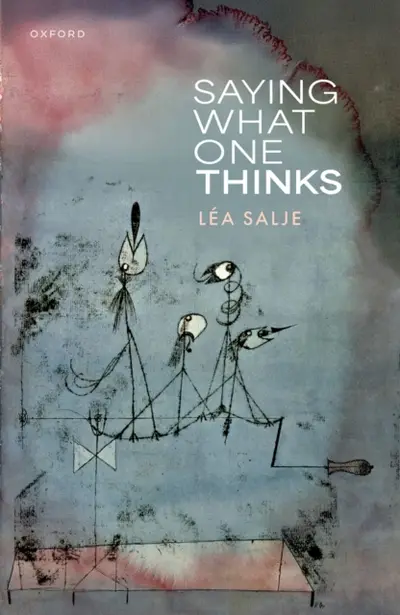
Saying What One Thinks
Price and availability
$77.99
Available in: Andorra, Austria, Australia, Belgium, Bulgaria, Canada, Switzerland, Cyprus, Czechia, Germany, Denmark, Estonia, Spain, Finland, France, United Kingdom, Guernsey, Greece, Croatia, Hungary, Ireland, Isle of Man, Iceland, Italy, Jersey, Japan, Liechtenstein, Lithuania, Luxembourg, Latvia, Monaco, Malta, Netherlands, Norway, Poland, Portugal, Romania, Sweden, Slovenia, Slovakia, San Marino, United States, Vatican City, South Africa
Stores: US, UK, Canada, EU, Australia.
Sign in to buyThe price is re-checked by the server before payment.
For personal use under the eBook licence.
- Format
- DRM
- Not stated by the publisher
- Language
- English
- Publisher
- Oxford University Press
- Published
- 12 March 2025
- ISBN
- 9780198914198
- Subjects
- Philosophy: epistemology & theory of knowledge, Philosophy of mind, Philosophy: aesthetics, Social & political philosophy, Philosophy: epistemology and theory of knowledge, Philosophy of mind, Philosophy: aesthetics, Social and political philosophy
About this book
Saying what one thinks can be difficult; sometimes one knows that a thought is there, but it takes time and effort to find its proper articulation. This book is about articulatory self-knowledge, or the sort of knowledge about one's own mind that results from successful attempts to articulate evasive thoughts of this kind. Rather than account for this phenomenon as mere verbal blockage or hermeneutical impoverishment, Lea Salje argues that the obstacle to articulation in these cases has to do with the representational metaphysics of the thought. When it first occurs, the thought has the wrong representational format to serve as the content of a sentence -- work must be done on it before it can be uttered aloud. What results is a picture of a little explored form of psychological self-knowledge that reveals hidden parts of one's mind to oneself even as one goes about creating the thought in its new, articulated form. The final parts of the book explore the role of conversation in drawing out articulations of this kind, and the possible expression of thoughts in art. By the end of Saying What One Thinks, articulatory self-knowledge no longer looks like a mere quirk of our psychology, but emerges as a central feature of distinctively human cognition.
Bibliographic data © Gardners Books Ltd.