EPUB · English
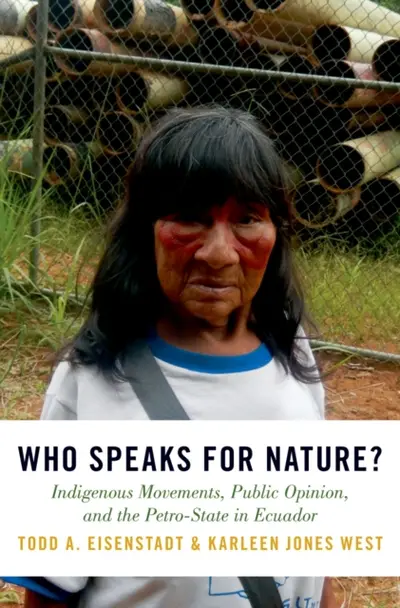
Who Speaks for Nature?
Indigenous Movements, Public Opinion, and the Petro-State in Ecuador
Price and availability
$89.99
Available in: Andorra, Austria, Australia, Belgium, Bulgaria, Canada, Switzerland, Cyprus, Czechia, Germany, Denmark, Estonia, Spain, Finland, France, United Kingdom, Guernsey, Greece, Croatia, Hungary, Ireland, Isle of Man, Iceland, Italy, Jersey, Japan, Liechtenstein, Lithuania, Luxembourg, Latvia, Monaco, Malta, Netherlands, Norway, Poland, Portugal, Romania, Sweden, Slovenia, Slovakia, San Marino, United States, Vatican City, South Africa
Stores: US, UK, Canada, EU, Australia.
Sign in to buyThe price is re-checked by the server before payment.
For personal use under the eBook licence.
- Format
- EPUB
- DRM
- Not stated by the publisher
- Language
- English
- Publisher
- Oxford University Press
- Published
- 14 March 2019
- ISBN
- 9780190908973
- Subjects
- Ecuador, Indigenous peoples, Comparative politics, Political activism, The environment, Ecuador, JBSL11, Comparative politics, Political activism / Political engagement, The environment
About this book
In 2009, Ecuador became the first nation ever to enshrine rights for nature in its constitution. Nature was accorded inalienable rights, and every citizen was granted standing to defend those rights. At the same time, the government advanced a policy of "e;extractive populism,"e; buying public support for mineral mining by promising that funds from the mining would be used to increase public services. This book, based on a nationwide survey and interviews about environmental attitudes among citizens as well as indigenous, environmental, government, academic, and civil society leaders in Ecuador, offers a theory about when and why individuals will speak for nature, particularly when economic interests are at stake. Parting from conventional social science arguments that political attitudes are determined by ethnicity or social class, the authors argue that environmental dispositions in developing countries are shaped by personal experiences of vulnerability to environmental degradation. Abstract appeals to identity politics, on the other hand, are less effective. Ultimately, this book argues that indigenous groups should be the stewards of nature, but that they must do so by appealing to the concrete, everyday vulnerabilities they face, rather than by turning to the more abstract appeals of ethnic-based movements.
Bibliographic data © Gardners Books Ltd.