PDF · English
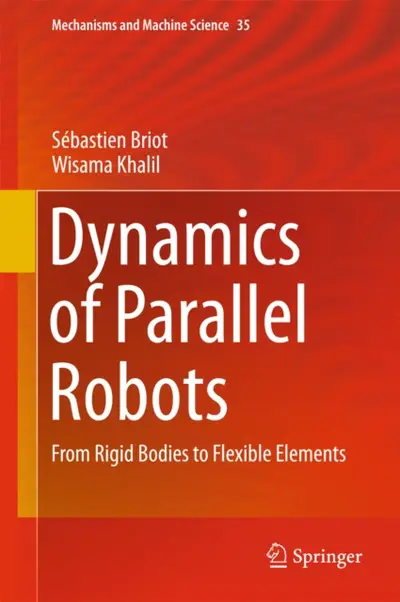
Dynamics of Parallel Robots
From Rigid Bodies to Flexible Elements
Price and availability
$120.99
Available in: Andorra, Austria, Australia, Belgium, Bulgaria, Canada, Switzerland, Cyprus, Czechia, Germany, Denmark, Estonia, Spain, Finland, France, United Kingdom, Guernsey, Greece, Croatia, Hungary, Ireland, Isle of Man, Iceland, Italy, Jersey, Japan, Liechtenstein, Lithuania, Luxembourg, Latvia, Monaco, Malta, Netherlands, Norway, Poland, Portugal, Romania, Sweden, Slovenia, Slovakia, San Marino, United States, Vatican City, South Africa
Stores: US, UK, Canada, EU, Australia.
Sign in to buyThe price is re-checked by the server before payment.
For personal use under the eBook licence.
- Format
- DRM
- Not stated by the publisher
- Language
- English
- Publisher
- Springer International Publishing
- Published
- 22 June 2015
- ISBN
- 9783319197883
- Subjects
- Dynamics & statics, Mechanical engineering, Electrical engineering, Robotics, Mechanical engineering, Engineering: Mechanics of solids, Automatic control engineering
About this book
This book starts with a short recapitulation on basic concepts, common to any types of robots (serial, tree structure, parallel, etc.), that are also necessary for computation of the dynamic models of parallel robots. Then, as dynamics requires the use of geometry and kinematics, the general equations of geometric and kinematic models of parallel robots are given. After, it is explained that parallel robot dynamic models can be obtained by decomposing the real robot into two virtual systems: a tree-structure robot (equivalent to the robot legs for which all joints would be actuated) plus a free body corresponding to the platform. Thus, the dynamics of rigid tree-structure robots is analyzed and algorithms to obtain their dynamic models in the most compact form are given. The dynamic model of the real rigid parallel robot is obtained by closing the loops through the use of the Lagrange multipliers. The problem of the dynamic model degeneracy near singularities is treated and optimaltrajectory planning for crossing singularities is proposed. Lastly, the approach is extended to flexible parallel robots and the algorithms for computing their symbolic model in the most compact form are given. All theoretical developments are validated through experiments.
Bibliographic data © Gardners Books Ltd.