PDF · English
Unholy Traffic
Slave Trading in the Civil War South
Price and availability
$25.99
Available in: Andorra, Austria, Australia, Belgium, Bulgaria, Canada, Switzerland, Cyprus, Czechia, Germany, Denmark, Estonia, Spain, Finland, France, United Kingdom, Guernsey, Greece, Croatia, Hungary, Ireland, Isle of Man, Iceland, Italy, Jersey, Japan, Liechtenstein, Lithuania, Luxembourg, Latvia, Monaco, Malta, Netherlands, Norway, Poland, Portugal, Romania, Sweden, Slovenia, Slovakia, San Marino, United States, Vatican City, South Africa
Stores: US, UK, Canada, EU, Australia.
Sign in to buyThe price is re-checked by the server before payment.
For personal use under the eBook licence.
- Format
- DRM
- Not stated by the publisher
- Language
- English
- Publisher
- Oxford University Press
- Published
- 22 March 2024
- ISBN
- 9780197578278
- Subjects
- USA, History of the Americas, Slavery & abolition of slavery, American Civil War, Ethnic minorities & multicultural studies, Economic history, United States of America, USA, JBSL1, Economic history, NHK, NHTS, NHWR3
About this book
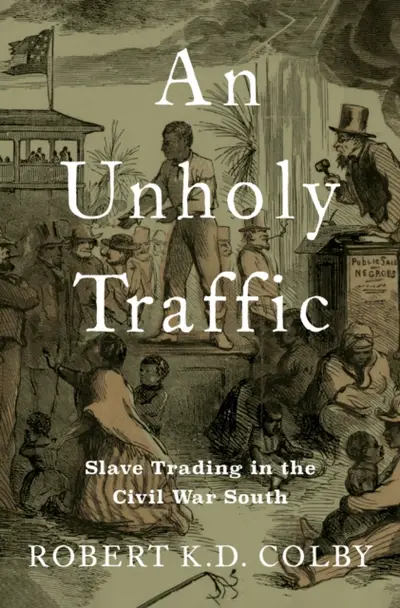
The Confederate States of America was born in defense of slavery and, after a four-year struggle to become an independent slaveholding republic, died as emancipation dawned. Between Fort Sumter to Appomattox, Confederates bought and sold thousands African American men, women, and children. These transactions in humanity made the internal slave trade a cornerstone of Confederate society, a bulwark of the Rebel economy, and a central part of the experience of the Civil War for all inhabiting the American South. As An Unholy Traffic shows, slave trading helped Southerners survive and fight the Civil War, as well as to build the future for which they fought. They mitigated the crises the war spawned by buying and selling enslaved people, using this commerce to navigate food shortages, unsettled gender roles, the demands of military service, and other hardships on the homefront. Some Rebels speculated wildly in human property, investing in slaves to ward off inflation and to buy shares in the slaveholding nation they hoped to create. Others traded people to counter the advance of emancipation. Given its centrality to their nationhood, Confederates went to great lengths to prolong the slave trade, which, in turn, supported the Confederacy. For those held in slavery, the surviving slave trade dramatically shaped their pursuit of freedom, inserting a retrograde movement into some people's journeys toward liberty while inspiring others to make the risky decision to escape. Offering an original perspective on the intersections of slavery, capitalism, the Civil War, and emancipation, Robert K.D. Colby illuminates the place of the peculiar institution within the Confederate mind, the ways in which it underpinned the CSA's war effort, and its impact on those attempting to seize their freedom.
Bibliographic data © Gardners Books Ltd.