EPUB · English
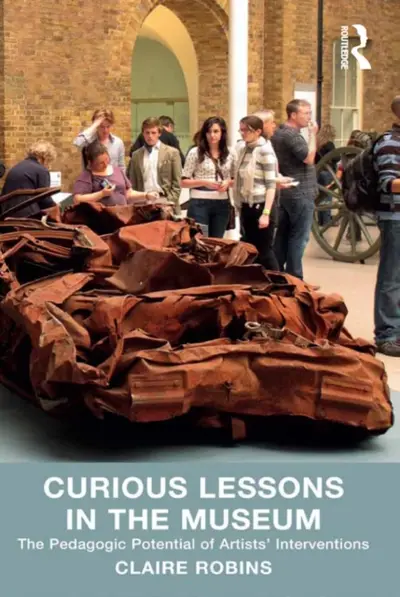
Curious Lessons in the Museum
The Pedagogic Potential of Artists'' Interventions
Price and availability
$58.99
Available in: Andorra, Austria, Australia, Belgium, Bulgaria, Canada, Switzerland, Cyprus, Czechia, Germany, Denmark, Estonia, Spain, Finland, France, United Kingdom, Guernsey, Greece, Croatia, Hungary, Ireland, Isle of Man, Iceland, Italy, Jersey, Japan, Liechtenstein, Lithuania, Luxembourg, Latvia, Monaco, Malta, Netherlands, Norway, Poland, Portugal, Romania, Sweden, Slovenia, Slovakia, San Marino, United States, Vatican City, South Africa
Stores: US, UK, Canada, EU, Australia.
Sign in to buyThe price is re-checked by the server before payment.
For personal use under the eBook licence.
- Format
- EPUB
- DRM
- Not stated by the publisher
- Language
- English
- Publisher
- Taylor & Francis
- Published
- 13 May 2016
- ISBN
- 9781317155522
- Subjects
- Theory of art, History of art & design styles: from c 1900 -, Art & design styles: Modernist design & Bauhaus, Theatre studies, Library & information sciences, Museum, historic sites, gallery & art guides, Theory of art, History of art, Theatre studies, Museology and heritage studies
About this book
Amongst recent contemporary art and museological publications, there have been relatively few which direct attention to the distinct contributions that twentieth and twenty-first century artists have made to gallery and museum interpretation practices. There are fewer still that recognise the pedagogic potential of interventionist artworks in galleries and museums. This book fills that gap and demonstrates how artists have been making curious but, none-the-less, useful contributions to museum education and curation for some time. Claire Robins investigates in depth the phenomenon of artists' interventions in museums and examines their pedagogic implications. She also brings to light and seeks to resolve many of the contradictions surrounding artists' interventions, where on the one hand contemporary artists have been accused of alienating audiences and, on the other, appear to have played a significant role in orchestrating positive developments to the way that learning is defined and configured in museums. She examines the disruptive and parodic strategies that artists have employed, and argues for that they can be understood as part of a move to re-establish the museum as a discursive forum. This valuable book will be essential reading for students and scholars of museum studies, as well as art and cultural studies.
Bibliographic data © Gardners Books Ltd.