EPUB · English
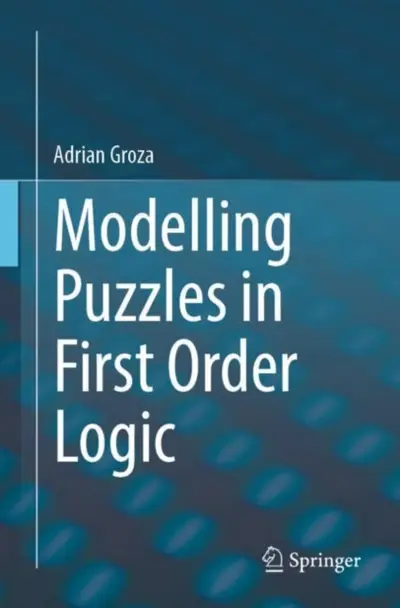
Modelling Puzzles in First Order Logic
Price and availability
$60.99
Available in: Andorra, Austria, Australia, Belgium, Bulgaria, Canada, Switzerland, Cyprus, Czechia, Germany, Denmark, Estonia, Spain, Finland, France, United Kingdom, Guernsey, Greece, Croatia, Hungary, Ireland, Isle of Man, Iceland, Italy, Jersey, Japan, Liechtenstein, Lithuania, Luxembourg, Latvia, Monaco, Malta, Netherlands, Norway, Poland, Portugal, Romania, Sweden, Slovenia, Slovakia, San Marino, United States, Vatican City, South Africa
Stores: US, UK, Canada, EU, Australia.
Sign in to buyThe price is re-checked by the server before payment.
For personal use under the eBook licence.
- Format
- EPUB
- DRM
- Not stated by the publisher
- Language
- English
- Publisher
- Springer International Publishing
- Published
- 26 October 2021
- ISBN
- 9783030625474
- Subjects
- Educational equipment & technology, computer-aided learning (CAL), Mathematical foundations, Mathematical logic, Computer science, Mathematical theory of computation, Artificial intelligence, Educational equipment and technology, computer-aided learning (CAL), Mathematical foundations, Mathematical logic, Mathematical theory of computation, Artificial intelligence (AI)
About this book
Keeping students involved and actively learning is challenging. Instructors in computer science are aware of the cognitive value of modelling puzzles and often use logical puzzles as an efficient pedagogical instrument to engage students and develop problem-solving skills. This unique book is a comprehensive resource that offers teachers and students fun activities to teach and learn logic. It provides new, complete, and running formalisation in Propositional and First Order Logic for over 130 logical puzzles, including Sudoku-like puzzles, zebra-like puzzles, island of truth, lady and tigers, grid puzzles, strange numbers, or self-reference puzzles.Solving puzzles with theorem provers can be an effective cognitive incentive to motivate students to learn logic. They will find a ready-to-use format which illustrates how to model each puzzle, provides running implementations, and explains each solution.This concise and easy-to-follow textbook is a much-needed support tool for students willing to explore beyond the introductory level of learning logic and lecturers looking for examples to heighten student engagement in their computer science courses.
Bibliographic data © Gardners Books Ltd.