PDF · English
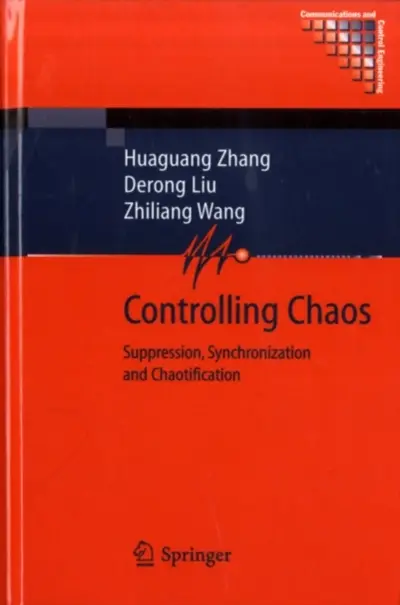
Controlling Chaos
Suppression, Synchronization and Chaotification
Price and availability
$175.99
Available in: Andorra, Austria, Australia, Belgium, Bulgaria, Canada, Switzerland, Cyprus, Czechia, Germany, Denmark, Estonia, Spain, Finland, France, United Kingdom, Guernsey, Greece, Croatia, Hungary, Ireland, Isle of Man, Iceland, Italy, Jersey, Japan, Liechtenstein, Lithuania, Luxembourg, Latvia, Monaco, Malta, Netherlands, Norway, Poland, Portugal, Romania, Sweden, Slovenia, Slovakia, San Marino, United States, Vatican City, South Africa
Stores: US, UK, Canada, EU, Australia.
Sign in to buyThe price is re-checked by the server before payment.
For personal use under the eBook licence.
- Format
- DRM
- Not stated by the publisher
- Language
- English
- Publisher
- Springer London
- Published
- 18 June 2009
- ISBN
- 9781848825239
- Subjects
- Cybernetics & systems theory, Calculus & mathematical analysis, Chaos theory, Dynamics & statics, Mechanical engineering, Electrical engineering, Artificial intelligence, Cybernetics and systems theory, Engineering: Mechanics of solids, Automatic control engineering, Artificial intelligence (AI)
About this book
Controlling Chaos achieves three goals: the suppression, synchronisation and generation of chaos, each of which is the focus of a separate part of the book. The text deals with the well-known Lorenz, Rossler and Henon attractors and the Chua circuit and with less celebrated novel systems. Modelling of chaos is accomplished using difference equations and ordinary and time-delayed differential equations. The methods directed at controlling chaos benefit from the influence of advanced nonlinear control theory: inverse optimal control is used for stabilization; exact linearization for synchronization; and impulsive control for chaotification. Notably, a fusion of chaos and fuzzy systems theories is employed. Time-delayed systems are also studied. The results presented are general for a broad class of chaotic systems.This monograph is self-contained with introductory material providing a review of the history of chaos control and the necessary mathematical preliminaries for working with dynamical systems.
Bibliographic data © Gardners Books Ltd.