EPUB · English
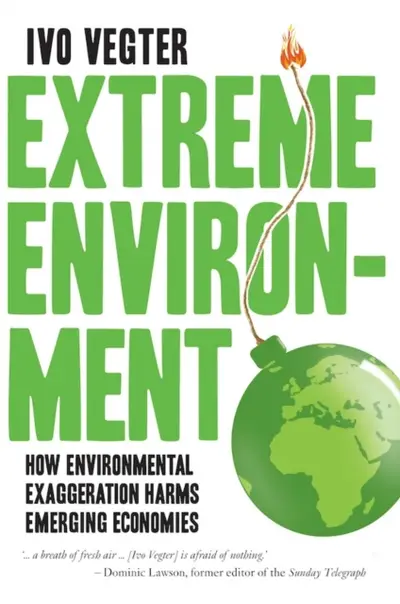
Extreme Environment
How environmental exaggeration harms emerging economies
Price and availability
$12.99
Available in: Andorra, Austria, Australia, Belgium, Bulgaria, Canada, Switzerland, Cyprus, Czechia, Germany, Denmark, Estonia, Spain, Finland, France, United Kingdom, Guernsey, Greece, Croatia, Hungary, Ireland, Isle of Man, Iceland, Italy, Jersey, Japan, Liechtenstein, Lithuania, Luxembourg, Latvia, Monaco, Malta, Netherlands, Norway, Poland, Portugal, Romania, Sweden, Slovenia, Slovakia, San Marino, United States, Vatican City, South Africa
Stores: US, UK, Canada, EU, Australia.
Sign in to buyThe price is re-checked by the server before payment.
For personal use under the eBook licence.
- Format
- EPUB
- DRM
- Not stated by the publisher
- Language
- English
- Publisher
- Penguin Random House South Africa
- Published
- 5 September 2012
- ISBN
- 9781770223653
- Subjects
- Environmentalist thought & ideology, Conservation of the environment, Green politics / ecopolitics / environmentalism
About this book
Extreme Environment promises to provoke fresh and spirited debate about the modern environmental movement and the many ways in which environmentalism, media, economics, public policy and the politics of liberty intersect. In order to reduce poverty and continue to raise living standards requires a sensible, balanced approach to a healthy, productive environment. No country, but especially not those in the developing world, can afford to be manipulated by the self-interested moralising and alarmism perpetrated by some special interest groups. Exaggeration by environmentalists, many journalists and even some scientists causes undue fear and anxiety among those who dont already dismiss the green lobby for crying wolf. Worse, misinformation affects regulation and policymaking in ways that actively harm developing economies. Starting with well-researched work questioning the claims of opponents to shale-gas drilling, or fracking, Ivo Vegter argues that public opinion and policy ought to be informed by accurate data and reasoned argument. Using a wide range of examples, from nuclear accidents and oil spills to food additives and agricultural chemicals, he demonstrates why we should be as sceptical of the emotive rhetoric of environmentalists, which just as often turns out to be alarmist, or even false, as we are of corporate spin. Globally relevant, but offering a unique perspective from a developing country South Africa this book is a must-read for every thinking person who cares about the world we live in.
Bibliographic data © Gardners Books Ltd.