PDF · English
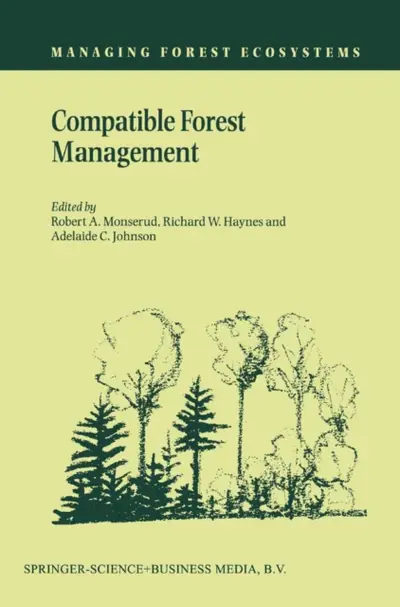
Compatible Forest Management
- Economics, business & finance
- Science & mathematics
- Nature, environment & geography
- Technology & engineering
Price and availability
$337.99
Available in: Andorra, Austria, Australia, Belgium, Bulgaria, Canada, Switzerland, Cyprus, Czechia, Germany, Denmark, Estonia, Spain, Finland, France, United Kingdom, Guernsey, Greece, Croatia, Hungary, Ireland, Isle of Man, Iceland, Italy, Jersey, Japan, Liechtenstein, Lithuania, Luxembourg, Latvia, Monaco, Malta, Netherlands, Norway, Poland, Portugal, Romania, Sweden, Slovenia, Slovakia, San Marino, United States, Vatican City, South Africa
Stores: US, UK, Canada, EU, Australia.
Sign in to buyThe price is re-checked by the server before payment.
For personal use under the eBook licence.
- Format
- DRM
- Not stated by the publisher
- Language
- English
- Publisher
- Springer Netherlands
- Published
- 17 April 2013
- ISBN
- 9789401703093
- Subjects
- Forestry & related industries, Environmental management, Forestry & silviculture: practice & techniques, Ecological science, the Biosphere, Environmental management, Forestry and silviculture
About this book
Public debate has stimulated interest in finding greater compatibility among forest management regimes. The debate has often portrayed management choices as tradeoffs between biophysical and socioeconomic components of ecosystems. Here we focus on specific management strategies and emphasize broad goals such as biodiversity, wood production and habitat conservation while maintaining other values from forestlands desired by the public. We examine the following proposition: Commodity production (timber, nontimber forest products) and the other forest values (biodiversity, fish and wildlife habitat) can be simultaneously produced from the same area in a socially acceptable manner. Based on recent research in the Pacific Northwest, we show there are alternatives for managing forest ecosystems that avoid the divisive arena of 'either-or' choices. Much of the work discussed in this book addresses two aspects of the compatibility issue. First, how are various forest management practices related to an array of associated goods and services? Second, how do different approaches to forest management affect relatively large and complex ecosystems?
Bibliographic data © Gardners Books Ltd.