PDF · English
Enemy Number One
The United States of America in Soviet Ideology and Propaganda, 1945-1959
Price and availability
$22.99
Available in: Andorra, Austria, Australia, Belgium, Bulgaria, Canada, Switzerland, Cyprus, Czechia, Germany, Denmark, Estonia, Spain, Finland, France, United Kingdom, Guernsey, Greece, Croatia, Hungary, Ireland, Isle of Man, Iceland, Italy, Jersey, Japan, Liechtenstein, Lithuania, Luxembourg, Latvia, Monaco, Malta, Netherlands, Norway, Poland, Portugal, Romania, Sweden, Slovenia, Slovakia, San Marino, United States, Vatican City, South Africa
Stores: US, UK, Canada, EU, Australia.
Sign in to buyThe price is re-checked by the server before payment.
For personal use under the eBook licence.
- Format
- DRM
- Not stated by the publisher
- Language
- English
- Publisher
- Oxford University Press
- Published
- 1 November 2018
- ISBN
- 9780190681470
- Subjects
- Russia, 20th century, c 1945 to c 2000 (Post-war period), European history, Postwar 20th century history, from c 1945 to c 2000, History: specific events & topics, Archaeology, Political ideologies, Political control & freedoms, 3MP, 3MPQ, Political ideologies and movements, Political control and freedoms, NH, NHD, NHT, NK
About this book
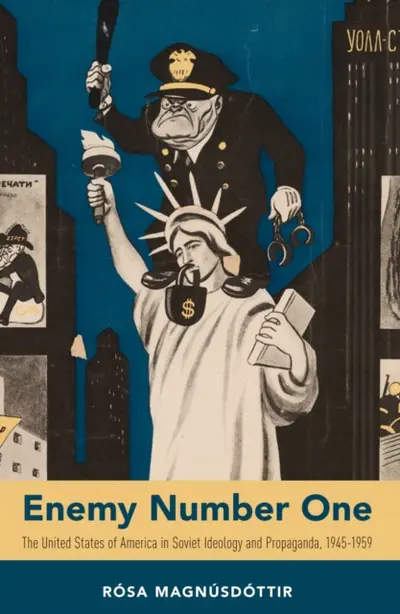
Enemy Number One tells the story of the Soviet cultural and propaganda apparatus and its efforts to control information about the United States in the postwar landscape. Beginning with the 1945 meeting of American and Soviet troops on the Elbe, this period saw cultural relations develop in close connection to oppression as the Soviet authorities attempted to contain and appropriate images of the United States. Rosa Magnusdottir analyzes two official narratives about the USSR's "e;enemy number one"e; --Stalin's anti-American campaign and Khrushchev's policy of peaceful coexistence--and shows how each relied on the legacy of the wartime alliance in their approach. Stalin used the wartime experience to spread fear of a renewed war, while Khrushchev used the wartime alliance as proof that the two superpowers could work together. Drawing from extensive archival resources, Magnusdottir brings to life the propaganda warriors and ideological chiefs of the early Cold War period in the Soviet Union, revealing their confusion and insecurities as they attempted to navigate the uncertain world of late Stalin and early Khrushchev cultural bureaucracy. She also demonstrates how concerned Soviet authorities were by their people's presumed interest in the United States, resorting to monitoring and even repression-behavior indicative of the inferiority complex of the Soviet project as it related to the outside world.
Bibliographic data © Gardners Books Ltd.