PDF · English
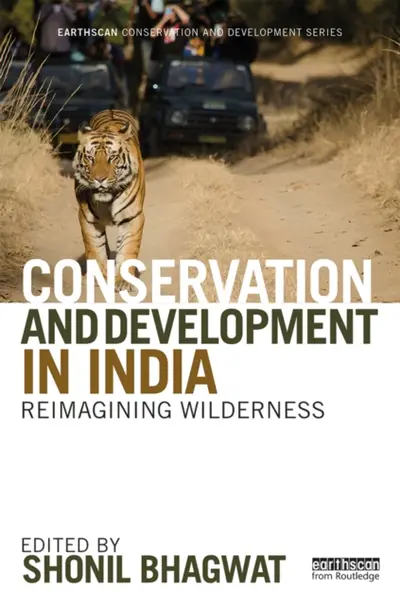
Conservation and Development in India
Reimagining Wilderness
Price and availability
$63.99
Available in: Andorra, Austria, Australia, Belgium, Bulgaria, Canada, Switzerland, Cyprus, Czechia, Germany, Denmark, Estonia, Spain, Finland, France, United Kingdom, Guernsey, Greece, Croatia, Hungary, Ireland, Isle of Man, Iceland, Italy, Jersey, Japan, Liechtenstein, Lithuania, Luxembourg, Latvia, Monaco, Malta, Netherlands, Norway, Poland, Portugal, Romania, Sweden, Slovenia, Slovakia, San Marino, United States, Vatican City, South Africa
Stores: US, UK, Canada, EU, Australia.
Sign in to buyThe price is re-checked by the server before payment.
For personal use under the eBook licence.
- Format
- DRM
- Not stated by the publisher
- Language
- English
- Publisher
- Taylor & Francis
- Published
- 17 January 2018
- ISBN
- 9781317413547
- Subjects
- Development studies, Development economics & emerging economies, Applied ecology, Conservation of the environment, India, Development studies, Public administration / Public policy, Conservation of wildlife and habitats
About this book
Despite decades of efforts to integrate conservation and development, India is torn between two very different worldviews of peoples' place in the country's natural environment. This book takes a critical look at nature conservation and poverty alleviation in India. It opens up discussion of the conservation-development nexus in a country that stands at a major crossroads, where forces of neoliberalism, globalisation and urbanisation are driving the future of India's environment. As the book shows, conservation in India is increasingly concerned with creating 'theme parks' - inviolate, albeit isolated, spaces for wild nature, whereas development is concerned with fast-tracking the construction of built infrastructure while also rolling out nationwide welfare programmes - promising food, clothing and shelter for the poorest of the poor living in rural India. Conservation and development therefore have very different motivations and attempts to find a common ground have been fraught with challenges. This has been particularly so on the fringes of wildlife parks, where the rural poor come in frequent contact with wild animals to the detriment of both people and wildlife. Chapters are written by leading scholars on India to provide a vision of the future of Indian nature conservation. Whilst focused on India, the book will also be of interest to scholars and researchers of conservation and development more globally. As a 'rising power', the world's eyes are set on India's development trajectory and there is unprecedented interest in the course of development that the world's largest democracy takes in the decades to come.
Bibliographic data © Gardners Books Ltd.