PDF · English
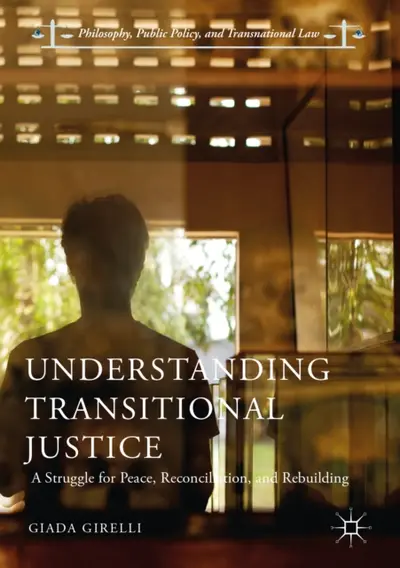
Understanding Transitional Justice
A Struggle for Peace, Reconciliation, and Rebuilding
Price and availability
$148.99
Available in: Andorra, Austria, Australia, Belgium, Bulgaria, Canada, Switzerland, Cyprus, Czechia, Germany, Denmark, Estonia, Spain, Finland, France, United Kingdom, Guernsey, Greece, Croatia, Hungary, Ireland, Isle of Man, Iceland, Italy, Jersey, Japan, Liechtenstein, Lithuania, Luxembourg, Latvia, Monaco, Malta, Netherlands, Norway, Poland, Portugal, Romania, Sweden, Slovenia, Slovakia, San Marino, United States, Vatican City, South Africa
Stores: US, UK, Canada, EU, Australia.
Sign in to buyThe price is re-checked by the server before payment.
For personal use under the eBook licence.
- Format
- DRM
- Not stated by the publisher
- Language
- English
- Publisher
- Springer International Publishing
- Published
- 3 July 2017
- ISBN
- 9783319536064
- Subjects
- Peace studies & conflict resolution, Social & political philosophy, Political science & theory, Jurisprudence & general issues, Jurisprudence & philosophy of law, International law, International humanitarian law, Peace studies and conflict resolution, Political science and theory, Methods, theory and philosophy of law, Public international law: humanitarian law, Social and political philosophy
About this book
The book is an accurate and accessible introduction to the complex and dynamic field of transitional and post-conflict justice, providing an overview of its recurring concepts and debated issues. Particular attention is reserved to how these concepts and issues have been addressed, both theoretically and literally, by lawyers, policy-makers, international bodies, and other actors informing the practice. By presenting significant, if undeniably disputable, alternatives to mainstream theories and past methods of addressing past injustice and (re)building a democratic state, the work aims to illustrate some foundational themes of transitional justice that have emerged from a diverse set of discussions. The author's position thus arrives from a careful analysis of the advantages and disadvantages of answers to the question: how, after a traumatic social experience, is justice restored?
Bibliographic data © Gardners Books Ltd.