EPUB · English
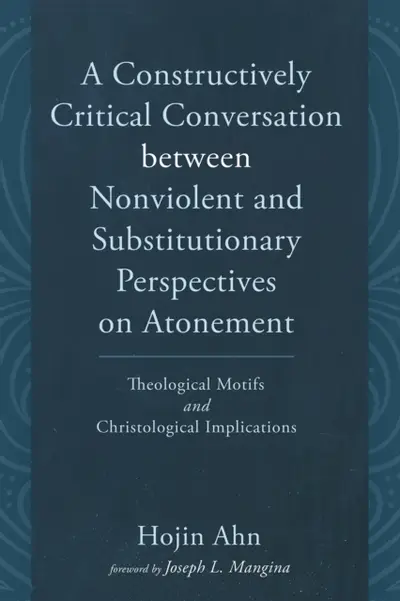
Constructively Critical Conversation between Nonviolent and Substitutionary Perspectives on Atonement
Theological Motifs and Christological Implications
Price and availability
$36.99
Available in: Andorra, Austria, Australia, Belgium, Bulgaria, Canada, Switzerland, Cyprus, Czechia, Germany, Denmark, Estonia, Spain, Finland, France, United Kingdom, Guernsey, Greece, Croatia, Hungary, Ireland, Isle of Man, Iceland, Italy, Jersey, Japan, Liechtenstein, Lithuania, Luxembourg, Latvia, Monaco, Malta, Netherlands, Norway, Poland, Portugal, Romania, Sweden, Slovenia, Slovakia, San Marino, United States, Vatican City, South Africa
Stores: US, UK, Canada, EU, Australia.
Sign in to buyThe price is re-checked by the server before payment.
For personal use under the eBook licence.
- Format
- EPUB
- DRM
- Not stated by the publisher
- Language
- English
- Publisher
- Wipf and Stock Publishers
- Published
- 21 December 2021
- ISBN
- 9781666723892
- Subjects
- Christian theology, Violence in society, Violence and abuse in society, Religious ethics, Christianity
About this book
In the contemporary theological world, traditional substitutionary accounts of Christ's atoning work have increasingly come under criticism for what is said to be their propensity for encouraging violence by a variety of theologians such as feminists, pacifists, and Girardians. Cur deus homo?, the question about God's sovereign purpose in Christ's atoning work, is radically transposed into "e;who killed Jesus?"e; which is a provocative inquiry into the ethical issues surrounding divine violence from the nonviolent perspective of atonement. Nonetheless, in this monograph, contrary to their nonviolent intention, you will witness that Brock, Schwager, and Weaver violently damage a "e;holistic"e; dimension of atonement event under the human cause of the victim Jesus' crucifixion by evil. By contrast, you will hear the harmonized voices of Anselm, Calvin, and Barth, who adamantly proclaim the incarnated Son of God's sovereignty in his self-giving death for our salvation. Furthermore, it is through the theological conversation between the opposite camps that you will realize how the anthropological motifs of healing, scapegoat mechanism, and nonviolence are to be constructively engaged with the Christological-cultic context of an evangelical doctrine of substitution. You will encounter the crux of Christ's saving death for us.
Bibliographic data © Gardners Books Ltd.