PDF · English
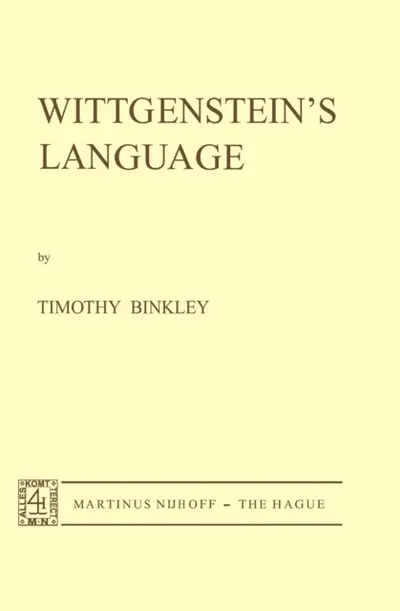
Wittgenstein's Language
Price and availability
$120.99
Available in: Andorra, Austria, Australia, Belgium, Bulgaria, Canada, Switzerland, Cyprus, Czechia, Germany, Denmark, Estonia, Spain, Finland, France, United Kingdom, Guernsey, Greece, Croatia, Hungary, Ireland, Isle of Man, Iceland, Italy, Jersey, Japan, Liechtenstein, Lithuania, Luxembourg, Latvia, Monaco, Malta, Netherlands, Norway, Poland, Portugal, Romania, Sweden, Slovenia, Slovakia, San Marino, United States, Vatican City, South Africa
Stores: US, UK, Canada, EU, Australia.
Sign in to buyThe price is re-checked by the server before payment.
For personal use under the eBook licence.
- Format
- DRM
- Not stated by the publisher
- Language
- English
- Publisher
- Springer Netherlands
- Published
- 6 December 2012
- ISBN
- 9789401024501
- Subjects
- Philosophy of language, Philosophy of language, Philosophical traditions and schools of thought
About this book
One of the first things to strike the reader of Wittgenstein's writings is the unique power of his style. One immediately notices the intriguing and arrangement of the paragraphs in Philosophical Investi- composition gations, or the stark assertiveness of the sentences in the Tractatus Logico- Philosophicus. A sense of the singular style being employed is unavoidable, even before the reader understands anything of what is happening philos- ophically. Perhaps precisely for this reason it is too often assumed that coming to understand either work has little or nothing to do with re- sponding to its form. The unusual style is a mere curiousity decorating the vehicle of Wittgenstein's ideas. Form is assigned a purely incidental import, there is a coincidence of this or that rhetorical flair with the yet to be determined content of the thoughts. The remarkableness of the style is perhaps registered in a tidy obiter dictum standing beside the more arduous task of discovering the substance of the ideas being presented. our interest, or at Wittgenstein's peculiar way of writing ably captures least our attention, but it bears only minor philosophical import. Though not unprecedented as a form of philosophical composition, it does not conform to the currently acceptable conventions; hence Wittgenstein's style is often thought to stand in the way of understanding his meaning. Such assumptions can be harmless for certain types of writing; however it does not appear as though Wittgenstein's is one of these.
Bibliographic data © Gardners Books Ltd.